Georgia


Special project: Who Are We?
In the “Who Are We?” series, The Christian Chronicle is…

|
Getting your Trinity Audio player ready...
|
ATLANTA — Hundreds of Christians came to Atlanta seeking true unity — not through platitudes but deep discussions about who belongs to the body of Christ, why divisions formed and what differences should be barriers to fellowship.
The 2025 Nehemiah Next Level Up Summit, hosted by the Renaissance Church of Christ, specifically tackled the history of division within the Restoration Movement, which began in the early 1800s and pleaded for a return to biblical authority and unity.
This is part of a series exploring the identity of Churches of Christ. Read more here.
By the 1906 U.S. Census, Christians associated with the movement had split into two groups: Churches of Christ and Disciples of Christ, or Christian Churches.
But the reasons for this disassociation were more complex than the single issue of instrumental music and brewed over several decades, panelists argued in a discussion on “The Reversal of 1906.”
Leaders and prominent publications among Churches of Christ took issue with other church practices deemed unbiblical “innovations,” said Leonard Allen, dean of the Bible college at Lipscomb University in Nashville, Tenn.
These practices included parachurch missionary societies, contracts for local preachers and cooperative meetings with denominations, Allen said.
But for many years, Restorationist churches maintained fellowship despite differences over these issues, said Rick Atchley, preacher for The Hills Church of Christ in Fort Worth, Texas.
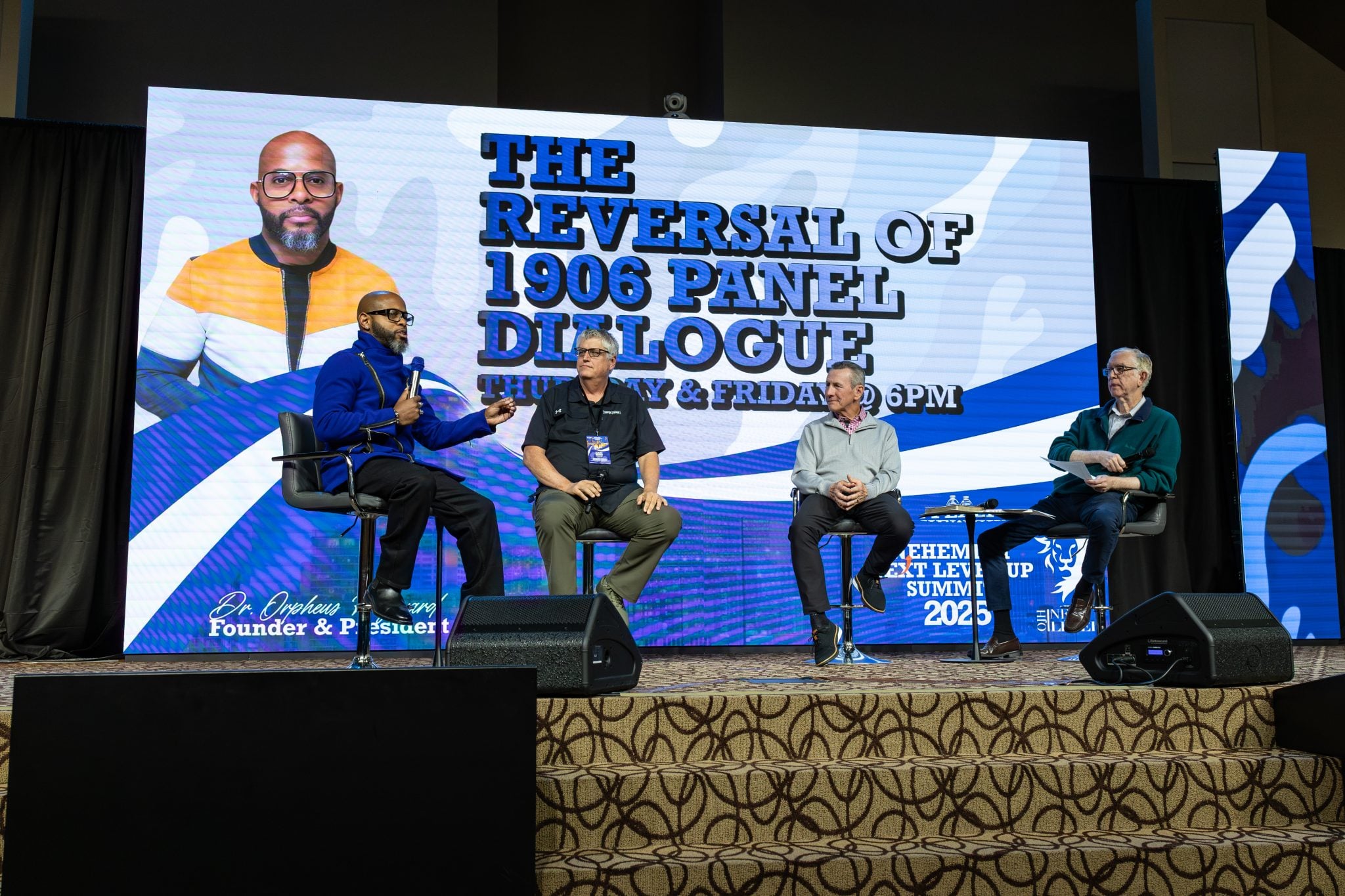
From left, Renaissance Church of Christ minister Orpheus Heyward moderates a panel on “The Reversal of 1906” with The Christian Standard publisher Jerry Harris, The Hills Church of Christ minister Rick Atchley and Lipscomb University Bible dean Leonard Allen.
Instead, Atchley pointed to the Civil War as the catalyst for division, as it was with other religious groups.
“We’re a confederation of autonomous congregations, so there’s no way to know officially that we had divided,” he said, “but the war divided us.”
Related: Special project: Who Are We?
The timing of the severed ties had mostly to do with post-war socioeconomic disparity, regional identity and rising denominationalism, Allen suggested in a separate seminar on Restoration history.
“This was a time when big cities were exploding in America and when middle class churchgoing people were prospering in the North, at least,” Allen told attendees. “They built church buildings that reflected their prosperity. They vied with each other to possess the tallest steeple as a symbol of prestige. They bought expensive pipe organs. They brought in professional musicians and more refined and better educated preachers who are more eloquent.”
Leaders among Churches of Christ in the late 1800s objected to what they saw as attempts “to make the church a fashionable place of resort and entertainment.”
Leaders among Churches of Christ in the late 1800s objected to what they saw as attempts “to make the church a fashionable place of resort and entertainment,” Allen added. Benjamin Franklin, editor of the American Christian Review, and Lipscomb University co-founder David Lipscomb — among others — believed that money should be used to help the poor, whom they felt would not find a place in these opulent church buildings.
Black Restoration Movement churches divided largely along the same lines as their White counterparts, with a group of Black Christians in Nashville, Tenn., splitting from the Disciples of Christ to form the Jackson Street Church of Christ around 1900. Marshall Keeble, the famed evangelist and founder of the Nashville Christian Institute, was a lifelong Jackson Street member.

Marshall Keeble sits with a few of his “boy preachers,” including Hassen Reed and Robert McBride, both standing, and Robert Wood and Fred Gray.
However, Renaissance minister Orpheus Heyward, who moderated the panel, addressed the feeling that “African Americans, within Churches of Christ, in the Restoration Movement, in this generation … seem to have been forgotten out of history, and we have been feeling rejected, and we don’t feel as welcomed.”
“That feeling and that thought process is a very real concept that I think still plays into the divide,” he added.
While Allen noted that race was not a central point to the overall division of the Restoration Movement, leaders such as Lipscomb strongly disapproved of segregation.
“To have two separate churches in the same town — one White, one Black — is a sin before God,” Lipscomb would say, though Allen pointed out that he could be paternalistic toward Black Christians. And his namesake university has previously apologized for its history of racism.
Even so, Black Churches of Christ would carve out a rich history of preachers and civil rights leaders — including Keeble, Fred Gray and Andrew Hairston.
The panel — only part of a three-day event that included worship and classes on a range of subjects — paid much attention to a lingering question for Christians today: Can there be fellowship through a difference over instrumental and a cappella worship?
In the panel, Allen noted the hermeneutics — or interpretive reasoning — behind Churches of Christ shunning instruments:
“The question was, what does the word of God require for the worship and work of the church? And they said, the answer is, God’s positive commands. … The question is not what is forbidden, but what is positively authorized, so positive law.”
Allen added that leaders such as Lipscomb and James Harding viewed transgressing God’s positive law for the function of the church as more severe than transgressing God’s moral law.
But Atchley suggested that Christians have not been consistent on the “silence of Scripture.”
“I think we devised a way of reading the Bible that was inherently going to divide us, because we were looking for ways to support our position on something,” he told the crowd.
“One who is a one-cupper would say that we are ignoring the silence of Scripture because the Scripture is silent on multiple cups, so you have a divide there.”
Heyward agreed there has been inconsistency, adding, “If you would ask us, ‘Is it OK to drink from more than one cup with the Lord’s Supper?’ — we would not have an issue with that. But one who is a one-cupper would say that we are ignoring the silence of Scripture because the Scripture is silent on multiple cups, so you have a divide there.”
The Atlanta preacher further urged Christians to be more considerate of genre and context when reading Scripture.

Orpheus Heyward speaks to the audience at the 1906 panel.
“The way you read law genre like Leviticus is not the way you read Ephesians,” Heyward said. “So when … you say that Ephesians 5 teaches that instrumental music is sin, you are forcing that conclusion on the text. The author himself is not addressing instrumental music. He was addressing paganism.”
But Heyward also cautioned, “This is not to sell you that we should have instruments or should not. … This is discussing … the facts of history that led to this 1906 divide, so that you’re at least informed about how we got where we are.”
The Nehemiah summit, with the theme “Anchored in Faith, Armed for Mission: A Restoration Vision for the Emerging Church,” echoed conversations at the 100th anniversary of the 1906 Census 20 years ago.
In 2006, events such as the Abilene Christian University Lectureship in Texas, Freed-Hardeman University’s “Contemporary Discussion” in Tennessee, the Tulsa International Soul-Winning Workshop in Oklahoma and the North American Christian Convention in Kentucky explored unity and cooperation between Churches of Christ and independent Christian Churches.

The April 2006 issue of The Christian Chronicle features a dialogue with Abilene Christian University’s then-president Royce Money amid the ACU lectures’ focus on a “spirit of unity.’
In the mid-20th century, the latter broke away from churches that would form the Disciples of Christ denomination. Independent Christian Churches remained much closer doctrinally to Churches of Christ, retaining their congregational autonomy and commitment to restoring New Testament Christianity.
“In this dawning of the 21st century, there is a renewed spirit of unity among us,” then-ACU President Royce Money said at the 2006 lectures. “Not for merging or for giving up long-held religious convictions that historically have divided us. Rather, it is a spirit of fellowship, of conversation, of reconciliation between estranged brothers and sisters.”

Alan Highers
But others, such as the late Harding University Bible professor and former Christian Chronicle editor Howard Norton, as well as the late longtime Spiritual Sword editor Alan Highers, warned of doctrinal compromise.
“Some are seeking unity without any discussion of the rightness or wrongness of instrumental music in worship,” Highers told the Chronicle in 2006. “They want to sweep the issue under the rug and ignore the real cause of division.”
As he did at the Nehemiah Summit, Atchley at the 2006 ACU lectures argued against inconsistent interpretation of Scripture.
“Where the Bible speaks, we speak,” he said at the time. “And where the Bible is silent, we have even more to say.” Atchley’s congregation, then known as the Richland Hills Church of Christ, added a Saturday night instrumental service in 2007 and later a Sunday morning instrumental worship alongside its a cappella service. The Nehemiah Summit host, the Renaissance church, does not use instruments.
In a second panel at the Nehemiah Summit, Bobby Harrington affirmed that independent Christian Churches, like a cappella Churches of Christ, share a loyalty to the kingship of Jesus, the authority of Scripture and the essentiality of baptism.
Each fellowship comprises roughly 1 million baptized members in the U.S., according to national surveys. Precise numbers are difficult to ascertain because of the autonomous nature of the individual congregations.
Harrington preaches for the Harpeth Christian Church in Franklin, Tenn., and co-founded renew.org, a faith-based nonprofit that produces Bible studies and advocates for Christian practices including discipling. He was a member of an a cappella Church of Christ in his native Canada and earned three degrees from Harding University in Searcy, Ark., which is associated with Churches of Christ.

Bobby Harrington, right, and Tra Beard participate in a second panel on “The Reversal of 1906.”
“When you look at the 200 years of Restoration Movement church history … we can veer to the right and get overly restrictive beyond what Scripture says, or we can veer to the left and try to make the Bible say what the culture says in progressivism,” Harrington warned.
But “we’re committed that Scripture alone is our final authority,” he added.
For his part, Heyward emphasized that the Atlanta summit was about establishing a dialogue.

The Renaissance Church of Christ praise team leads Nehemiah summit attendees in singing. Renaissance is a cappella.
“It can’t be wrong to fight for unity, and it can’t be wrong to have conversations that may be even difficult,” the preacher said. “That we may wrestle through where we have difference, but accept that we can be one body with difference. …
“This was about saying we don’t have to settle for divide, that I can sit on the same stage with someone who uses instruments while Renaissance is a cappella and say ‘That’s still my brother.’”
In a later sermon on “So then, what are the essentials?” Olu Shabazz used Acts 15 as an example of the need for discussion and deliberation.
“Sometimes you’ve got to let folks say what they’re going to say,” said Shabazz, minister for the Harlem Church of Christ in New York City. “Sometimes you’ve got to let them get it off their chest. Sometimes you’ve got to … (give) an opportunity for everybody to give their vantage point, their viewpoint — and then you come to a conclusion.”
The Harlem preacher also pointed to the value of historical context.

Olu Shabazz, minister for the Harlem Church of Christ in New York City, preaches on “the essentials” at the Nehemiah summit.
“If you want to understand the Church of Christ in the Bible, you’ve got to go to the Bible,” he said. “If you want to better understand the Churches of Christ in the Americas, then you must read and understand Restoration history.”
But Shabazz stressed that unity must be grounded in Scripture:
“I came to Atlanta tonight to say that it is a virtual impossibility to achieve anything that looks like and sounds like unity without laying your beliefs and your practices alongside the word of God.”
“It is a virtual impossibility to achieve anything that looks like and sounds like unity without laying your beliefs and your practices alongside the word of God.”
Ultimately, though, Heyward told Nehemiah attendees that Christians cannot create unity — they must find the unity God has already created.
“Any and all who obey the Gospel of Jesus Christ are placed in a state of unity,” he said. “A unity created by the Holy Spirit. … We have one body, but we don’t determine who’s in it. The Gospel does.”
CALVIN COCKRELL is Managing Editor for The Christian Chronicle and serves as the young adult minister for the North Tuscaloosa Church of Christ in Alabama. Reach him at [email protected].
In the “Who Are We?” series, The Christian Chronicle is…

LITTLE ROCK, ARK. — The vision for ReMission started small.…

The parable of the lost sheep wasn’t written about church…

The heartbeat of the American Restoration Movement is propelled by…

In church life as in much of life, we owe…

LITTLE ROCK, ARK. — Jeremie Beller is my designated driver.…
Your donation helps us not only keep our quality of journalism high, but helps us continue to reach more people in the Churches of Christ community.