Alabama

A ‘poor hater’ in D.C.
FALLS CHURCH, VA. — The Church of Christ in this…

|
Getting your Trinity Audio player ready...
|
MOORESVILLE, ALA. — For one Lord’s Day, a small white-clapboard church building became a refuge of peace and unity amid the Civil War.
Union and Confederate, Black and White, slave and free — all gathered in the one-room meetinghouse on a summer day in 1862 to hear a gospel sermon preached by Union Brig. Gen. James Garfield.
Related: A ‘poor hater’ in D.C.
“The only way that you can have that kind of union is in Christ,” said Chris Pressnell, a member of the board overseeing the Mooresville Church of Christ restoration project and preacher for the Flint Church of Christ in Decatur, Ala.
Two decades later, Garfield would become president of the restored Union — the only U.S. head of state with ties to Churches of Christ. He was a preacher associated with the Disciples of Christ, who at that time did not distinguish themselves from Churches of Christ within the broader Restoration Movement.

The historic Mooresville church building is undergoing restoration.
Before his visit to Mooresville, Garfield had participated in the Battle of Shiloh — an important Union victory in southwestern Tennessee — and subsequent siege of Corinth, Miss. He then led his brigade to repair the railroad between Corinth and Decatur, Ala., before camping in north Alabama, near Mooresville. Preacher and historian Earl Kimbrough documented the timeline in The Alabama Restoration Journal.
While soldiers made supply raids into the town — now on the National Register of Historic Places — the Mooresville church sent an invitation to Garfield.
“There is a church in the village of Mooresville near by and they have sent up inviting me to speak to them on Sunday. If I am not too unwell I have a notion to speak to them.”
It was likely written by J.H. Hundley, who helped found the congregation and had three sons fighting for the Confederacy.
Garfield wrote to his wife in a letter that historians date to July 5, 1862, “There is a church in the village of Mooresville near by and they have sent up inviting me to speak to them on Sunday. If I am not too unwell I have a notion to speak to them.”

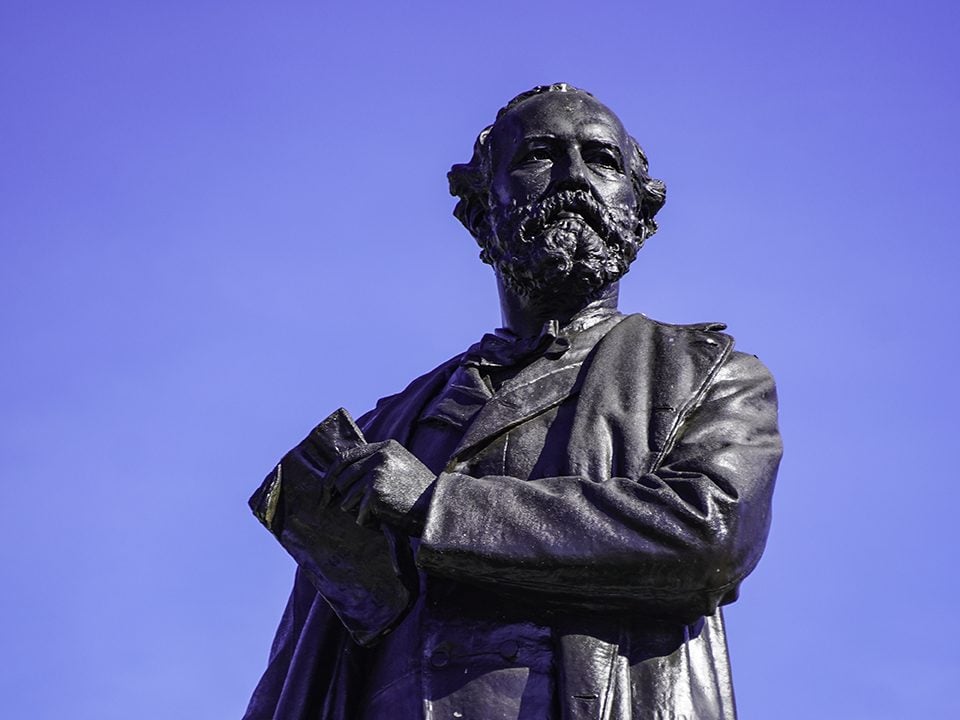
A statue of James A. Garfield stands outside the Capitol in Washington. An inscription on the reverse side reads “Major General U-S-V (United States Volunteers), Member of Congress, Senator and President of the United States of America.”
According to the story handed down by generations of Mooresville members, Garfield was well enough to come preach to the 25-member church. He brought a small detail with him from his brigade, which would have likely included 1,000 or more soldiers.
The congregational Bible from which the general may have preached — along with other church artifacts — is conserved by board member John Bryson. He preached for Mooresville from 1988 until the congregation stopped meeting nearly a decade later. Bryson’s wife, Terri, also has deep familial ties to the church.
Hundley, a doctor and slave owner, began reading the writings of Walter Scott, an early Restoration Movement figure, in 1839.
After becoming convinced he needed to be immersed in baptism for the remission of sins, he wrote to a Church of Christ 50 miles west in Tuscumbia, Ala. Christians there sent an evangelist, Carroll Kendrick, to preach in Mooresville.

A historic photo shows the original Mooresville Church of Christ meetinghouse, prior to the addition of a vestibule and side wings.
Within a year, a congregation of 70 formed. They met in the only church building in town, a “free house of worship” for all religious groups, according to historian C. Wayne Kilpatrick.
But after several years, a group of Presbyterians shut out the Church of Christ from assembling there. The congregation continued meeting in members’ homes until 1854, when they had enough resources to build a new one-room meeting place.

Floor markings indicate where a picket line likely would have separated slaves worshiping at the Mooresville church.
The church shared the building with two fraternal organizations, the Odd Fellows and Sons of Temperance, who helped fund its construction.
There’s evidence of a picketed area where Hundley’s slaves and perhaps others would have stood and worshiped — unusual at a time when Black slaves were often fully segregated from White worshipers.

The Mooresville church’s bell tower has been inaccessible for some time. Based on old photos, a weathervane formerly sat atop it.
There’s also an inaccessible bell tower, as well as signs of a second floor and staircase that may have existed at some point. Around 1937, two small wings were added on either side of the sanctuary.
Various visiting evangelists preached gospel meetings at the Mooresville church and helped convert more residents, including some influential community members and several members of the Presbyterian church. A prominent preacher in Churches of Christ, T.B. Larimore, held a meeting there in 1877.

An attendance board documents the church’s final meeting.
Mooresville never gained a full-time preacher, but the congregation endured faithfully for more than 150 years.
Its meeting place now stands as the oldest Church of Christ building on its original foundation in the state, Pressnell told The Christian Chronicle.
After the church closed its doors in 1997, having dwindled to about 15 worshipers, some of the former members kept a financial account to maintain the property. Eventually, they appointed a board of trustees to oversee the historic building.
Randy Jenkins, a member of the Chase Park Church of Christ in Huntsville, Ala., recalled how he became involved. Jenkins met the late Fred Boseck, a sixth-generation member of the Mooresville church, through the Diana Singing, an annual a cappella gathering in Tennessee that Jenkins directs.

Randy Jenkins and Chris Pressnell, board members overseeing the Mooresville Church of Christ property, stand in front of the historic meetinghouse.
Boseck persuaded Jenkins, a self-described lover of old buildings, to come look at the Mooresville building with several others in the 2000s.
“As we walked in the door, he handed us the key and said, ‘You’re a board member now,’” Jenkins recalled with a chuckle. “So I sort of got hooked into it.” Jenkins, Pressnell and Bryson are the three remaining original board members, along with four additions.
Related: One of America’s oldest Churches of Christ celebrates its 200th anniversary
In the past six years, the board has sought to restore the “gem of church history,” as Pressnell called it.
Restoration of the building’s exterior, including foundation and roof repairs, is mostly complete. Repair and restoration of the interior — including the ceiling, walls, floors and lighting — to its original look is underway, with help from a $75,000 grant from the Alabama Historical Commission.

The original 19th-century pews and floors remain in the Mooresville church building.
Hoping for some volunteer labor from area churches, board members estimate they’ll need an additional $70,000 to complete renovations.
That will involve updating the electrical system, adding heating and cooling, replacing windows, repairing siding and renovating the bathrooms in one of the side wings. It will also entail landscaping, painting and other exterior finishes, as well as erecting a historical marker.

Much of the interior of the sanctuary was gutted for restoration work.
But it’s not just about “preserving the wood,” Pressnell said. “We just want to preserve the story.
“We want to know, how can we all be unified? Well, they did that,” the minister added. “They brought unity with people from all different backgrounds, and the one common thread was Christ.”

Old photos and paintings of the Mooresville church sit atop the congregation’s original podium.
Even since the congregation disbanded, Christians have held occasional singings at the Mooresville church. With the restoration, board members hope to continue that tradition, as well as host gospel meetings and a regular worship service once a month for the community of about 50 residents.
They also intend to rent out the property as a wedding venue and use proceeds to fund future maintenance. Even then, the history of the place may preach its own gospel sermon.

An old, deteriorated sign for the Mooresville Church of Christ sits in storage in a side room.
“There are going to be people that walk through here that are going to read about (how) this is a church that wanted to go back to the Bible,” Pressnell said, “and have the Bible as their guide.”
A benefit singing for the Mooresville Church of Christ restoration project will be held at the Madison Church of Christ on May 15. To donate, visit mooresvillecocbuilding.org.
CALVIN COCKRELL is Managing Editor for The Christian Chronicle and serves as the young adult minister for the North Tuscaloosa Church of Christ in Alabama. Reach him at [email protected].
FALLS CHURCH, VA. — The Church of Christ in this…
TUCKERS CROSSROADS, Tenn. — The Bethlehem Church of Christ has a…

LOUISVILLE, Ky. — What’s the oldest Church of Christ in America?…

NASHVILLE, Tenn. — The Sunday sun streams through the Lindsley…

CORNERSVILLE, Tenn. — It might have been another victim of…

Minister shortages. Closing churches. Struggling theology schools. All are happening…
Your donation helps us not only keep our quality of journalism high, but helps us continue to reach more people in the Churches of Christ community.