‘Streams’ of Restoration movement converge at Stone-Campbell Dialogue
Mark Taylor, publisher and editor of The Christian Standard ,…

|
Getting your Trinity Audio player ready...
|
ABILENE, TEXAS — One theme in my recently published book, “Restoring the Restoration,” is the lack of study and application concerning the role of the Holy Spirit in our lives and our churches.

Purchase a digital pass to hear the presentations at this year’s Teleios Conference at teleiosconference.com.
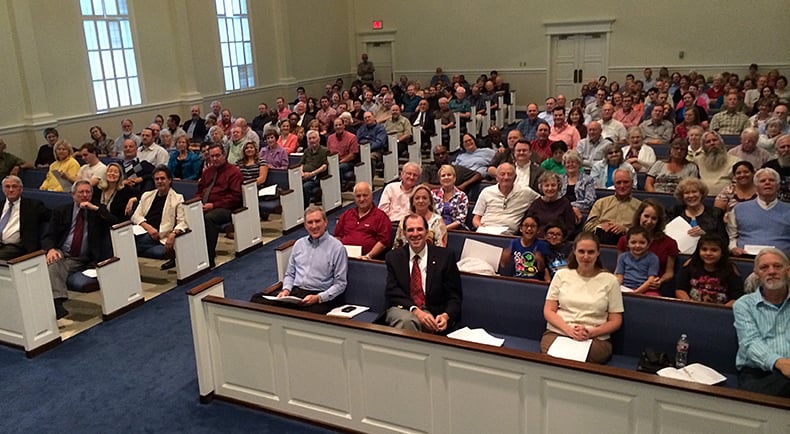
That’s why I was excited to attend the recent Teleios conference, “Spirituality in the Stone-Campbell Heritage, Past Present and Future.” This was my first experience with the conference, hosted by Teleios, a Journal to Promote Holistic Christian Spirituality in the beautiful chapel of Abilene Christian University.
Douglas Foster, a renowned church historian and an editor of “The Encyclopedia of the Stone-Campbell Movement,” was the first speaker. He opened by addressing the incorrect assumption that the Restoration Movement and its focus on rational thought were not conducive to promoting a relationship with the Holy Spirit.

Douglas A. Foster
Foster’s belief was accurately based on the outpouring of the Holy Spirit at the very first landmark event of the Restoration, the Cane Ridge Revival, held in Cane Ridge, Ky., in 1801. That event so changed Barton Stone that he left the Presbyterian ministry and started the Christian Church. Foster spent most of his talk contrasting the ministries of two 20th century theologians who were influential among Churches of Christ — Foy E. Wallace Jr. and Leroy Garrett. I found the discussion brilliant and illuminating.

Lauren Smelser White
Next, we heard from Lauren Smelser White, a professor at Lipscomb University, on “Spirituality and Hermeneutics,” and the role of the Holy Spirit working in and through Scripture. Stanley Talbert of Pepperdine University followed, speaking on “Spirituality and Justice.”
Randy Harris, a longtime Bible professor at Abilene Christian, led a plenary session on “Spirituality and Formation.” Harris spoke at length on the relationship of one’s view on soteriology and pneumatology to approaches to one’s spiritual life. During another session, we heard from Tera Harmon, an ACU professor, on “Spirituality and the Voices of Women.”
Jerry Taylor, a professor of Bible at ACU and director of the Carl Spain Center on Race Studies and Spiritual Action, delivered the final address of the conference, “The Future of Spirituality in the Stone-Campbell Heritage.” His was an amazing speech — I might add, sermon — that was very inspirational.
Next year’s Teleios Conference is scheduled for Feb. 26-28, 2026, at the Oblate School of Theology in San Antonio, Texas and online. I highly recommend it.
ROBERT L. HURLEY is a graduate of Abilene Christian University and former county judge for Atascosa County, Texas. He retired in 2022. He is the author of “Restoring the Restoration – the Christian Church: what went wrong?” and “The Life of the Apostle Philip,” a historical novel.
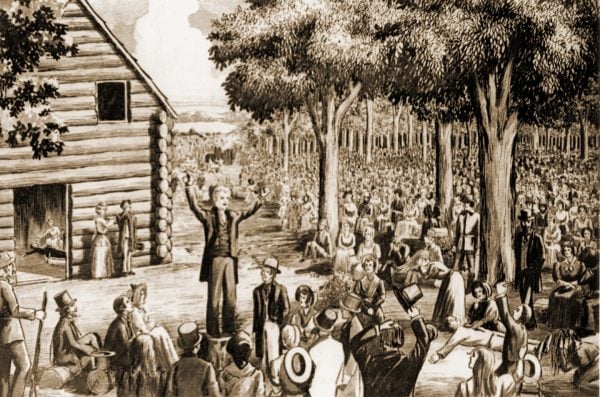
Associated with the Great Revival in the West (1797-1805), the Cane Ridge Meeting, Aug. 6-12, 1801, was the culmination of a wave of religious excitement that spread across northern Kentucky during the spring and summer of 1801. Beginning with the regularly scheduled four-day Presbyterian sacramental meeting at Fleming Creek, northeast of Lexington, the first weekend in May, attendance and the remarkable phenomena of “falling” increased at the regularly scheduled Presbyterian sacramental meetings that followed at Cabin Creek, Concord, Salem, Point Pleasant, Lexington, Indian Creek, and Paris. Methodists and Baptists joined in many of the meetings.
Mark Taylor, publisher and editor of The Christian Standard ,…

With unbridled enthusiasm, Olan Hicks launched into the first front-page…
The Apostles' what? America's roughly 1.4 million adherents of Churches…

To echo Edward J. Robinson in the foreword, John Young…

The editors of “The Living Pulpit: Sermons that Illustrate Preaching…

ABILENE, Texas — Off an interstate in suburban Memphis, Tenn.,…
Your donation helps us not only keep our quality of journalism high, but helps us continue to reach more people in the Churches of Christ community.