Texas
Texas
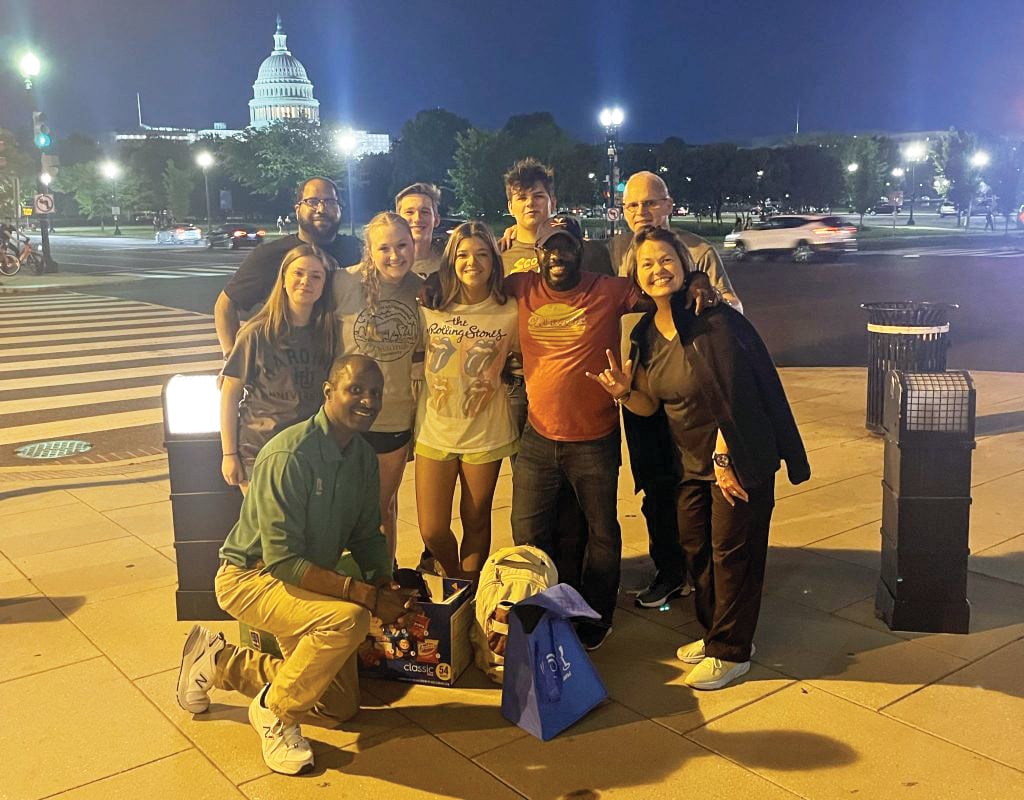
At an uncertain time, federal workers and ministers keep the faith
WASHINGTON — Every Sunday, some of the roughly 450,000 federal…

|
Getting your Trinity Audio player ready...
|
ABILENE, TEXAS — Maruj Rangel began to cry.
Her 10-year-old son, Isaías, rose from the couch where he was seated with his sister and father, crossing the room to comfort his mother, who speaks no English.
“What was it like to come here?” the translator had asked her in Spanish.
That’s when the tears started.
Related: At an uncertain time, federal workers and ministers keep the faith
What was it like to leave her life, her father with cancer, her mother suffering from Alzheimer’s, her eldest son, her home?
“It’s been very hard,” she responded through her friend Albert Acosta, recently retired minister for the Minter Lane Church of Christ in Abilene.
Tears require no translation.

Elvis and Maruj Rangel pose with their children, Hannah and Isaías.
The Rangels have become beloved members of the congregation since leaving Venezuela and immigrating to the U.S. with Temporary Protected Status nearly a year ago — status recently revoked by the Trump administration and under judicial scrutiny.
Elvis Rangel, Maruj’s husband, was only 13 when he first met Albert and Trisha Acosta in 1984. The couple had moved to Caracas, Venezuela’s capital city, to serve as missionaries. Elvis was already part of the Church of Christ there and soon became a favorite babysitter for the Acostas’ three young sons. In the process, he learned English by watching “Sesame Street” videos with the boys.
After the Acostas returned to Texas in 1993, they stayed in touch with Elvis, who soon married and started his own family. Things weren’t always so hard in Venezuela.
“Hospitals started collapsing. And sometimes I would stand in line over a day to buy just a little food.”
But six years after the Acostas returned to the States, Hugo Chávez was elected, “and things began to change drastically with his socialist policies,” Albert said. The decline continued until Chávez’s death in 2013 and grew worse under his successor, Nicolás Maduro. For the Rangels and other Venezuelans, that meant critical food and medicine shortages, constant blackouts and a lack of water.
“Hospitals started collapsing,” Elvis said. “And sometimes I would stand in line over a day to buy just a little food.”
For a time, the family moved to Maracaibo, the nation’s second-largest city, where things were a little better. Elvis, a front desk clerk at the Caracas Hilton before it closed, could work for the Intercontinental Hotel group in Maracaibo. He and Maruj planted a church, and for two years he also served as its minister, growing the congregation to about 80.

Retired Minter Lane minister Albert Acosta, right, listens as the Rangels tell their story.
The failing health of extended family members in Caracas prompted the Rangels to move back. For a brief time, things again seemed a little better. Elvis began preaching for the church there. But by 2016 and 2017, “the country started entering crisis after crisis,” Albert explained.
In 2019, the city went six days without electricity. At the time, Elvis’ brother — mentally handicapped and diabetic — lived with them, and they couldn’t keep his insulin refrigerated.
And Isaías — only 4 years old — was asthmatic and had two club feet. They had no electricity to run his breathing machine.
“We took him to a hospital, but they had no room. We went to another. They had no electricity. Finally, we went to a third. … They thought he was close to death. … They did what they could, but they had no medicine.”
“We took him to a hospital, but they had no room,” Elvis said. “We went to another. They had no electricity. Finally, we went to a third, where there was electricity. They thought he was close to death. He couldn’t breathe. They did what they could, but they had no medicine.”
Maruj had a little medicine in her purse that they could administer there.
“If not for that, he would have died,” Elvis said softly.
As his father talked, Isaías stood behind his mom, his head against her neck, arms around her shoulders. Handing her a Kleenex to wipe her eyes, he silently comforted the woman who had comforted him through eight surgeries on his feet performed in Venezuela and Ecuador.
After almost losing Isaías during the blackout, the family had a chance to move to the neighboring country to escape their homeland’s chaos. The journey took three days on a bus across Colombia, where they were stopped by guerillas who demanded payment for passage.
For two years, Elvis and Maruj worked as missionaries with the church in Ibarra, Ecuador. But eventually their visas expired, and they returned to Caracas.

Isaías Rangel, 10, comforts his mother, Maruj.
From there, after many delays and much paperwork, they came to the U.S. The Acostas had received government approval to sponsor them — including guaranteeing financial responsibility.
The Rangels lived in the Acostas’ spare bedroom for five months until Elvis and Maruj received work permits.
The family moved to a small guest house owned by a Minter Lane family free of charge. Life began to feel a little more normal.
Daughter Hannah, 15, tried — in English, her second language — to explain her complicated feelings after arriving in the U.S.
“One of the feelings I have never had before — and I don’t want to have in future,” she began.
She recalled being with her dad in the car in Houston, which was the family’s first stop after arriving by plane in Miami and going through immigration there.
“I felt like I was in an aquarium — without any door or window. I felt like I was in a box,” she continued. “It’s so emotional. I saw the street and all the cars and felt like I was stuck and couldn’t escape.”
In Abilene, she’s made friends at her high school and works hard to make good grades.

Albert Acosta
“The best part,” Hannah said, “is Albert and Trisha,” who they call Nana. “The way they treat us is so sweet. I feel like it’s my family and my home.”
Hannah wants to be a dentist, but she also loves art and earned a medal “for a painting about my feelings in my escuela” — her school. Isaías wants to be a professional soccer player. Or maybe an architect. Architects don’t need perfect feet.
Hannah especially misses her grandparents and her brother, who is an adult and thus couldn’t accompany the family under the rules for Temporary Protected Status, or TPS. He is married and lives near Caracas.
President George H.W. Bush established the program in 1990. Former residents of 16 countries have been granted TPS during various crises — such as war, natural disaster or humanitarian devastation.
TPS offers legal presence and a work permit. Elvis works as a school bus driver and Maruj in a school cafeteria. Venezuelans were granted TPS in 2021 and again in 2023 by former Secretary of Homeland Security Alejandro Mayorkas, with a term extending until 2026 and covering about 472,000 Venezuelans.
Related: Church-supported nonprofit loses, then regains, USAID funding after reprieve from Elon Musk
But on Feb. 5, President Donald Trump revoked TPS status for Venezuelans, setting off a series of court challenges. And on Tuesday, Secretary of State Marco Rubio reversed his previous stance and endorsed the Trump administration revocation of TPS for all Venezuelans. The Rangels received notification on March 31 that they should self-deport by April 24, or they could be detained and deported by authorities. They have an appointment to take Isaías to a surgeon in Dallas on April 28.
Elizabeth Alvarez, manager of civil litigation for the Guest and Gray law firm in Forney, Texas, formerly practiced immigration law and continues pro bono representation in the specialty. She is not the attorney for the Rangel family, who have retained an immigration attorney in Miami.
“TPS is at its base a promise from the U.S. that ‘We see you’re suffering, and we want to help.’ Revoking it early is a betrayal of the promise the U.S. has made to you and to the world.”
Alvarez, a graduate of Abilene Christian University and Pepperdine University’s law school, explained that TPS is a hybrid status. “It was never intended as a permanent residence but in most cases is never revoked.”
“TPS is at its base a promise from the U.S. that ‘We see you’re suffering, and we want to help.’ Revoking it early is a betrayal of the promise the U.S. has made to you and to the world,” the attorney explained.

Elizabeth Alvarez
“But it’s not a pathway to a green card or citizenship,” Alvarez said. Immigrants must have some other qualifying event.
The Rangels applied for asylum — a qualifying event — and did so prior to the Trump administration’s revocation of TPS for Venezuelans. That should afford protection from deportation, but losing TPS would mean losing work permits and possibly Elvis’ driver’s license.
And since asylum is managed through the State Department and TPS through Homeland Security, the potential for mistakes — or for one agency to disregard the status granted through another — remains.
The Rangels are not alone in their quandary.
More than 10 million Christian immigrants living in the U.S. were vulnerable to deportation at the end of 2024, the Center for the Study of Global Christianity found in its “One Part of the Body” report. And nearly 7 million Christian U.S. citizens share a household with those vulnerable to deportation.
The revocation has been challenged in court. At least one challenge has made it all the way to the U.S. Supreme Court, but it specifically applies to alleged members of Tren de Aragua, a violent Venezuelan gang, currently detained in Texas. Other cases out of California, Maryland and Massachusetts have challenged the revocation on other grounds.
Related: ‘God doesn’t see the borders’
Gang violence and criminal activity by Tren de Aragua members has been used to justify the TPS revocation. Ironically, families who feared the gangs in Venezuela have been swept up in the fear generated by the rhetoric and reality surrounding them in the U.S.
An officer stopped a friend of Elvis at the grocery store.
“Fortunately, he had his legal papers with him to prove he was here legally,” Elvis said.

Elvis Rangel and his children, Hannah and Isaías, share their experience of emigrating from Venezuela only to lose their status and begin searching again for a safe home.
Now, Elvis is fearful each time he goes in the store. The Rangels carry photocopies of their legal documents with them everywhere.
Hannah said most of her teachers are nice to her, but one older teacher approached her to ask if she was legal.
“She started asking me questions like, ‘You’re legal here?’ and I feel so uncomfortable. I told her I came on an airplane and went to immigration.”
Hannah still shook a little as she told the story, recalling the teacher saying, “But your people — Venezuelan people — have been illegals, and they are doing bad things in this country — and you need to be good person.”
Whatever the motivation, it felt threatening.
“And I feel so, so bad,” Hannah said. A friend apologized and said that teacher is just like that. “But I feel like I’m a bad person for being here — I know I’m not. I know I’m a good person.”
“One day I am going to school, and a teacher knocks strong. And it scared me because I think she’s with immigration.”
Isaías was in his classroom when someone knocked loudly on the door.
“One day I am going to school, and a teacher knocks strong. And it scared me because I think she’s with immigration,” the skinny fifth grader recalled, explaining he feared not just for himself, but for his friends, some of whom lack legal status. His understanding of immigration seems far more sophisticated than should be expected of a 10-year-old.
Leaving family in Venezuela was hard, Elvis said. Leaving their church was hard. Starting over in Ecuador, then in the U.S., was hard. But he wants American Christians to know that “wherever they go, Venezuelans are trying to help the churches. All over South America, they’re reviving the churches.”
So while they wait for clarity, they worship with their new church family at Minter Lane. And fight their fear as April 24 draws closer.
They might go to Spain, which has welcomed Latin American immigrants. Elvis would like to find a church there and preach. Venezuela is not an option. Not just because of the ongoing food and power and medical crises but because the U.S. stamp on their passports would put them in danger, Albert explained.
“I know as a Christian I should have faith. But I struggle not to be afraid.”
“I know as a Christian I should have faith,” Elvis said. “But I struggle not to be afraid.”
They want to stay here. So they pray for asylum, to keep their jobs and take Isaías to see the surgeon about his feet.
CHERYL MANN BACON is a Christian Chronicle contributing editor who served for 20 years as chair of the Department of Journalism and Mass Communication at Abilene Christian University. Contact [email protected].
WASHINGTON — Every Sunday, some of the roughly 450,000 federal…

Last Wednesday, Mark Moore sent an urgent message to the…
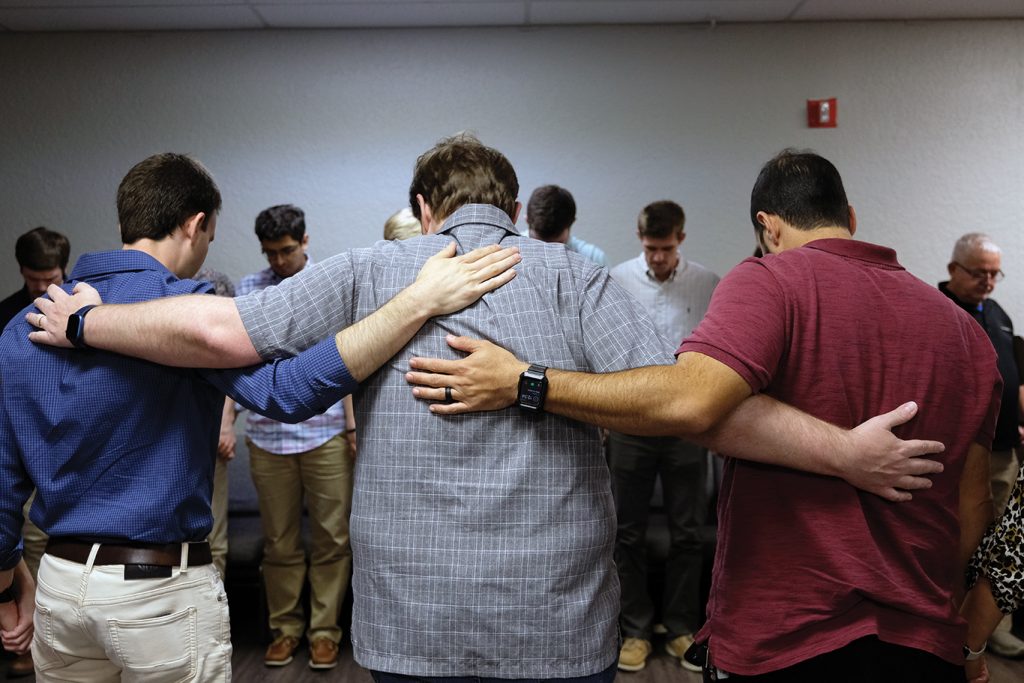
POMPANO BEACH, FLA. —“I L-O-V-E Y-O-U.” Maikon Borba, a leader…

An Iraqi refugee who serves as a Christian missionary in…
Christians’ response to immigration — more specifically to immigrants —…

VIENNA, Austria — “It was not our choice to come here.…
Your donation helps us not only keep our quality of journalism high, but helps us continue to reach more people in the Churches of Christ community.