

‘Do we really trust God enough to love our neighbors?’
'We Welcome Refugees,” declared the sign outside the Northlake Church…

|
Getting your Trinity Audio player ready...
|
Christians’ response to immigration — more specifically to immigrants — grows out of the biblical injunction to welcome the stranger, feed the hungry, protect the oppressed.
Prospects of a wall, a deportation mandate and more never-ending debates on Capitol Hill don’t change that obligation, regardless of politics or preferences. Those are decisions to be made by the government for the benefit of the governed, not by Christ followers for the benefit of the kingdom.

Yulia Merchant, far left, poses with refugees wearing Ukrainian outfits at the special Thanksgiving meal at the Memorial Church of Christ in Houston.
Moses and the prophets commanded Israel to treat foreigners among them fairly, generously and with compassion.
“Do not oppress a foreigner; you yourselves know how it feels to be foreigners, because you were foreigners in Egypt” (Exodus 23:9).
Related: ‘Do we really trust God enough to love our neighbors?’
“When a foreigner resides among you in your land, do not mistreat them” (Leviticus 19:33).
“Do not deprive the foreigner or the fatherless of justice, or take the cloak of the widow as a pledge” (Deuteronomy 24:17).
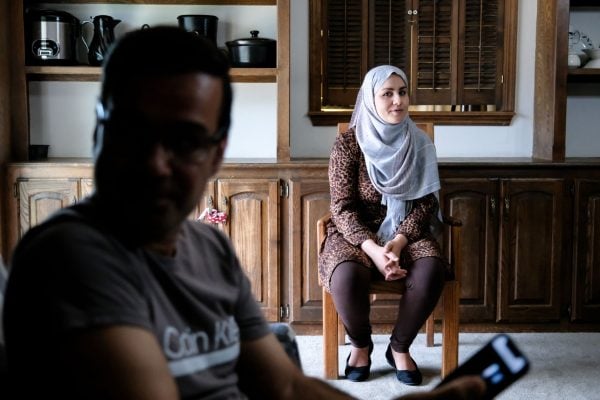
Azizah Hashemi listens to her husband, Mohammad, share stories about their escape from Afghanistan.
In the New Testament, Paul tells the Jews and Gentiles — foreigners to one another — how to welcome one another. And how to get along in this new kingdom — the church.
“Here there is no Gentile or Jew, circumcised or uncircumcised, barbarian, Scythian, slave or free, but Christ is all, and is in all” (Colossians 3:11).
“He came and preached peace to you who were far away and peace to those who were near. For through him we both have access to the Father by one Spirit” (Ephesians 2:17-18).
The concept of an undocumented immigrant or illegal immigrant is a relatively new one in human history. It’s certainly not one that was known in the centuries when Moses led the Israelites out of Egypt, or Paul instructed the growing and culturally diverse churches of Europe and Asia, times when borders were more elusive. For centuries, people, parents, clans and tribes have traversed the globe, often in wretched circumstances, sometimes in pursuit of opportunity, more often in pursuit of refuge.
Christians get a lot of things wrong as we navigate the political maelstrom that has consumed not just American politics but the politics of nations around the world. We get sucked in by the rhetoric of party leaders, both aspiring and ambitious, whose motives have far more to do with constituencies, donor bases and economics than justice, compassion and peacemaking.
“For centuries, people, parents, clans and tribes have traversed the globe, often in wretched circumstances, sometimes in pursuit of opportunity, more often in pursuit of refuge”
On this issue, by the grace of God, at least some of us have gotten things right.
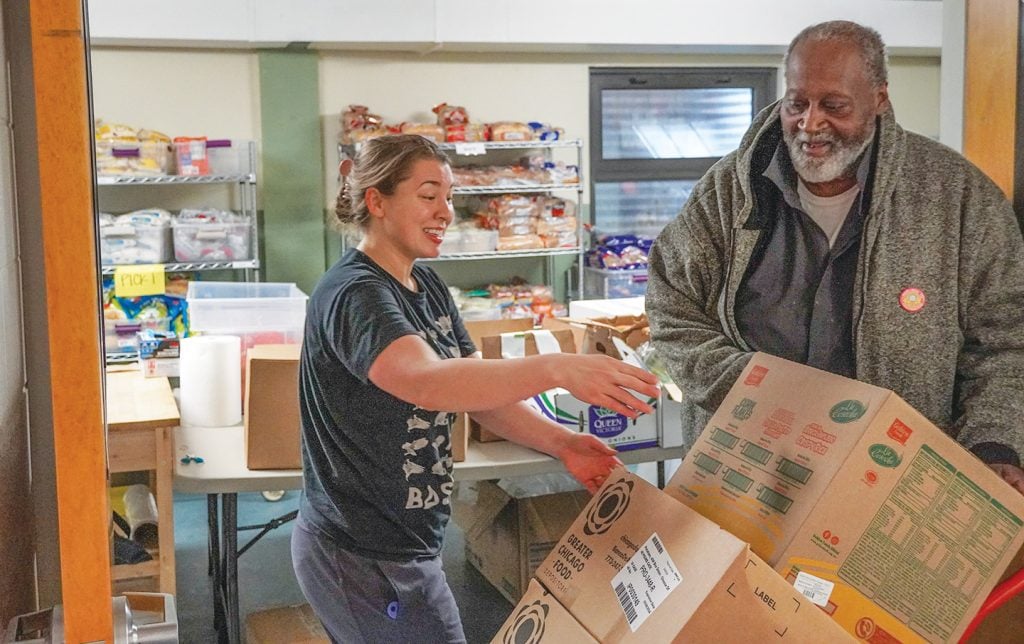
The Christian Chronicle has highlighted Christians serving the foreigners among us in this country and elsewhere. In this issue, we tell the story of a tiny church in Massachusetts teaching English to immigrants using Bible stories as their text. In 2024, we reported on a Houston church serving Ukrainians and a Chicago congregation feeding immigrants from Latin America, Ukraine and beyond. No one asks for papers. They just ask, “Are you hungry?”

English language students look on in a class taught by Gareth Flanary .
The civic, economic, educational and health care questions surrounding immigration demand better solutions than our elected leaders have provided thus far. They are real and important questions.
But they are not our questions. Our question must always be, “How can we serve you in the name of Jesus?”
CHERYL MANN BACON is a Christian Chronicle contributing editor who served for 20 years as chair of the Department of Journalism and Mass Communication at Abilene Christian University. Contact [email protected].
'We Welcome Refugees,” declared the sign outside the Northlake Church…
POMPANO BEACH, FLA. —“I L-O-V-E Y-O-U.” Maikon Borba, a leader…

Editor's note: This story originally appeared in the November 2014…

REYNOSA, Mexico — Virginia Chaves knows what people think of…

An Iraqi refugee who serves as a Christian missionary in…

CHICAGO — He traveled more than 5,000 miles, dodging human…
Your donation helps us not only keep our quality of journalism high, but helps us continue to reach more people in the Churches of Christ community.