
Why counting the sheep is so difficult
The parable of the lost sheep wasn’t written about church…

|
Getting your Trinity Audio player ready...
|
In church life as in much of life, we owe a lot to the scholars and researchers whose eyes light up over obscure factoids or nerdy data.
This is part of a series exploring the identity of Churches of Christ. Read more here.
These curious people do hard, tedious work. They ask questions that challenge us. Sometimes they ask questions that make us uncomfortable.
Most religious groups have some sort of data gathering entity. Ryan Burge, a political scientist with the Danforth Center on Religion and Politics at Washington University in St. Louis, studies them all. Except for Churches of Christ — because we don’t have a centralized system of data gathering.
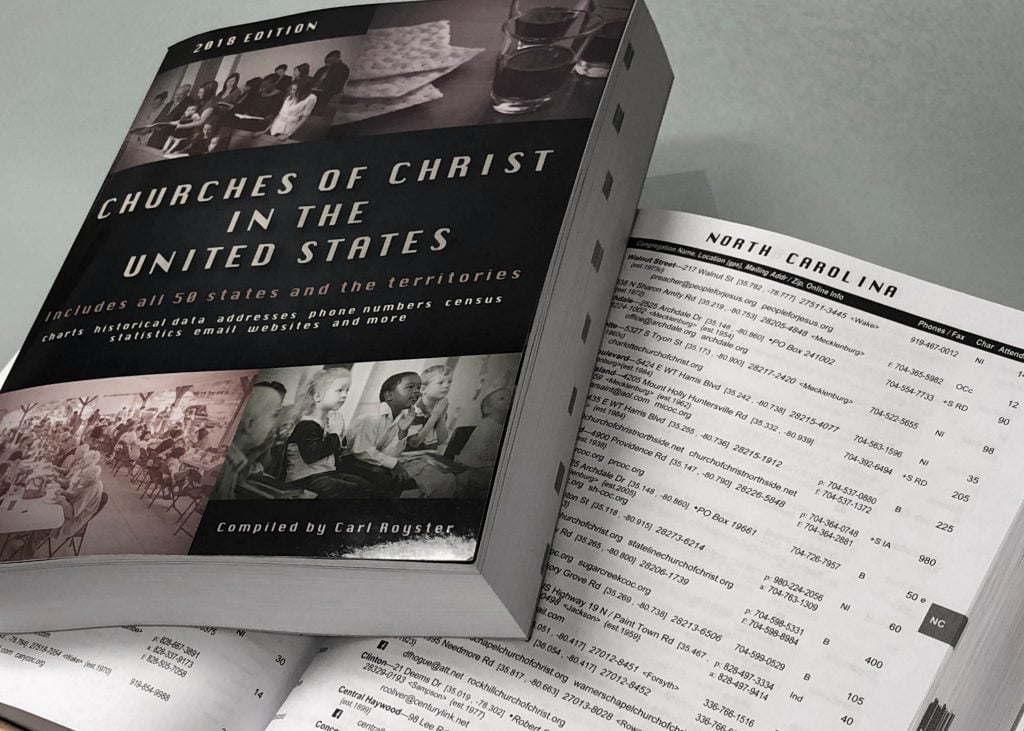
The “Churches of Christ in the United States” directory is the closest we get to a systematic census. Thus the ongoing effort to update it, cleanse the database of churches that no longer exist and confirm the contact information and other relevant details becomes increasingly important.
Getting a clear-eyed view of ourselves — whether we’re growing or shrinking and where, why and how — is especially crucial. The Church Research Council was formed to gather that information, comprising Heritage21, 21st Century Christian, Abilene Christian University’s Siburt Institute for Church Ministry and The Christian Chronicle.

Past editions of the 21st Century Christian directory are displayed. Respond to the new census survey here.
Suzie Macaluso, sociologist and researcher for the council, crafted the survey the independent group is using to resurrect the directory that went dark during the COVID-19 pandemic. This survey goes beyond directory information to ask other questions designed to help us see ourselves more clearly.
The census is not complete. Numbers are not yet firm. But with every state now represented, researchers can begin to extrapolate the data that forms a clearer picture. That said, we know numbers don’t tell our whole story.
Part of the story is told in the way autonomy has led to division as reflected in the nine different codes of groups and subgroups among the non-institutional congregations, which comprise roughly 10 percent of all congregations nationwide. Other codes reflect ethnic differences or information about serving military populations. But church members all over the U.S. and stories on the pages of the Chronicle sadly illustrate that mainstream churches often are beset by division as well.
“I can go to a Church of Christ in any state and know pretty much what to expect. But they are still radically different in terms of what they emphasize in theology and the lines they draw.”
“I can go to a Church of Christ in any state and know pretty much what to expect,” Macaluso said. “But they are still radically different in terms of what they emphasize in theology and the lines they draw.”
First-century churches were filled with Greeks, Hellenistic Jews and Roman Gentiles. Missives from the Jerusalem church and letters from Paul sought to calm the storms of disagreement as new Christians from radically different cultures tried to figure out how to do church.
Related: Why counting the sheep is so difficult
Two millennia later, we still haven’t figured out how to achieve the unity for which Christ prayed, “so that they may be one as we are one.”
A new directory and online database will not unify us. Only the saving grace of Jesus can do that. But doing this one thing together, in every corner of our diverse, autonomous collection of congregations — small and large, rural and urban, Black, White, traditional and progressive — can help us get a clearer answer to the question, “Who Are We?”
CHERYL MANN BACON is a contributing editor for The Christian Chronicle. She served for 20 years as chair of the Department of Journalism and Mass Communication at Abilene Christian University in Texas.
The parable of the lost sheep wasn’t written about church…

Are Churches of Christ declining in the United States? “That’s…

In the “Who Are We?” series, The Christian Chronicle is…

The heartbeat of the American Restoration Movement is propelled by…

ATLANTA — Hundreds of Christians came to Atlanta seeking true…
As a data collector, Carl Royster said he and his…
Your donation helps us not only keep our quality of journalism high, but helps us continue to reach more people in the Churches of Christ community.