

Iranian Christians cling to faith and hope as they witness attacks
Fear mixed with hope. That’s how Christians from the Middle…

|
Getting your Trinity Audio player ready...
|
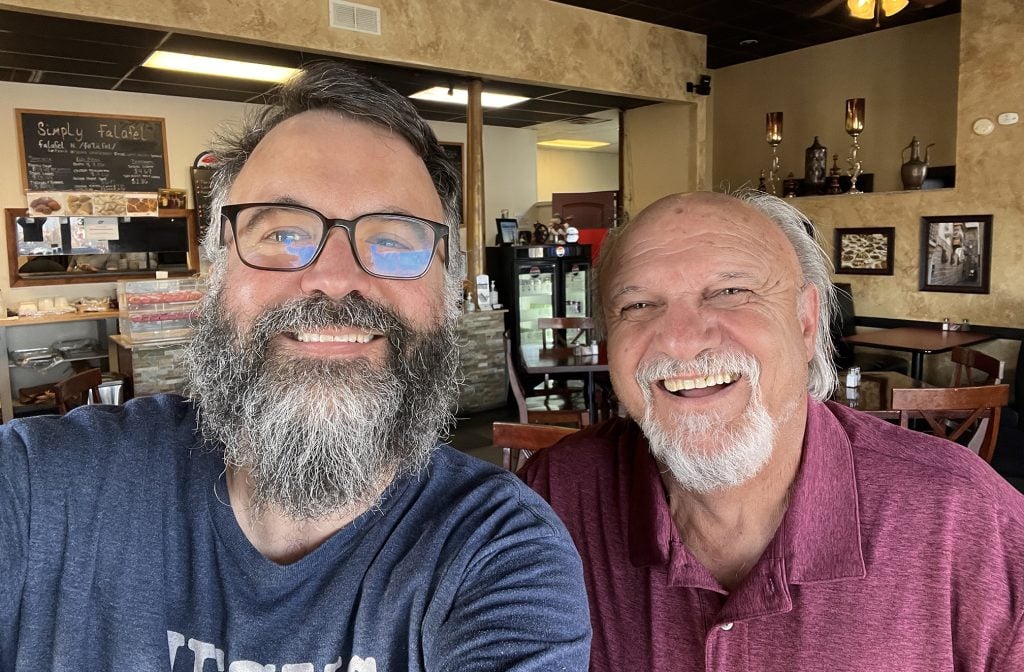
EDMOND, OKLA. — I arranged to meet my new friend Tony at a falafel place for lunch on Saturday.
That morning, my home country attacked his.
Tony found out several hours before I did. He’d been up since 2 a.m., when messages from his friends and family in Iran flooded his phone. It was a rare night when he forgot to silence his WhatsApp account, and it turned out to be providential.
Related: Iranian Christians cling to faith and hope as they witness attacks
“My family is safe,” he said. “Yes, and I’m very happy and excited.”

Erik and Tony prepare to part ways after lunch at Simply Falafel in Edmond, Okla.
I met Tony when he was my Uber driver to the airport for my trip to the Red Tie Gala in St. Lucia last year. I’ve had a lot of interesting airport rides in two-plus decades with The Christian Chronicle. A guy in Sarajevo told me that his country had pyramids with mystic powers. One driver was convinced that the Denver airport is haunted. (Seriously, they have a horse statue nicknamed “Blucifer.”) And there was the lady who, at 3 a.m., had a song blaring all the way to Will Rogers Airport — “I hope that heaven has a smoking section!” (If you’re in the smoking section, that ain’t heaven, pal.)
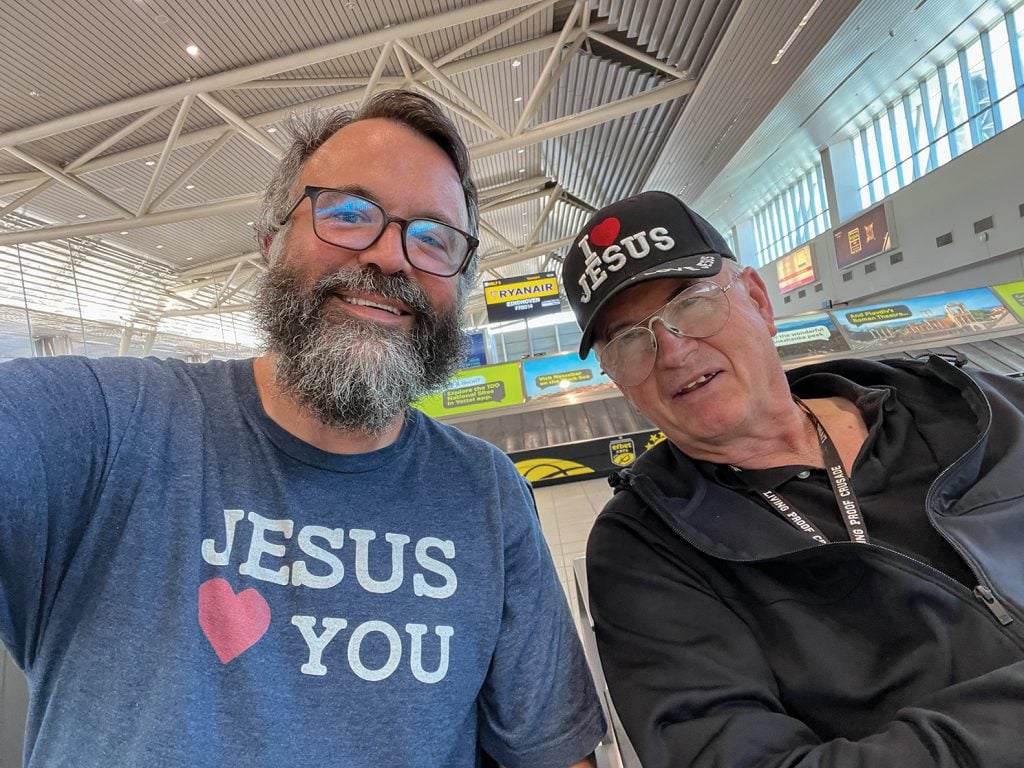
Tony was different. “I like your shirt!” he hollered as soon as he pulled into my driveway. I had on the “Jesus ❤ You” T-shirt I got from The Park Church of Christ in Tulsa, Okla., a few years back. It has become my airport shirt and has sparked some wonderful conversations, as I’ve mentioned before.
Related: T-shirt evangelism uses ‘cymbalism’

At the airport in Sofia, Bulgaria, Erik Tryggestad meets Steve Rice of Oskaloosa, Iowa, who traveled to the European nation as part of a mission trip to train Bulgarian evangelists.
Tony, who worships with a Baptist church in Oklahoma City, has traveled all over the world working with Farsi-speaking believers. After many years as a preacher, he now leads a ministry that helps Western Christians effectively share Jesus with their Muslim neighbors.
I got his number and promised to stay in touch. Four months later, I finally made good on that promise.
At lunch, Tony told me about growing up in Iran, where he started attending mosque at age 5. (His surname, Emamghoraishi, competes with mine in length and pronounceability.) By his teen years, Tony had questions about his faith that his teachers struggled to answer. He balked against the justifications for holy war, for killing infidels and shuddered at the frightening depictions of hell and eternal punishment that he heard over and over.

On top of a Farsi-language Bible open to the prophet Isaiah, an Iranian Christian named Miriam flips through her own copy of a Farsi New Testament. She has highlighted the parable of the Pearl of Great Price in the Gospel of Matthew. The Christian Chronicle spoke with Miriam in 2018 when she was living as a refugee in Athens, Greece.
As a Farsi speaker, he didn’t understand why Islam required him to learn Arabic. But it was the Muslim call to prayer that really puzzled him. He knew he was supposed to face Qibla, the direction of the Kaaba in Mecca. But what if he were at the North Pole, where every direction is south? That reminded me a bit of the “what if you get in a car wreck and die on the way to the baptistery” argument so many of us in Churches of Christ raised in our teen Bible classes.
Tony began studying to become a mullah, but the more he learned about Islam, the more dissatisfied he became. So he abandoned his faith and became an atheist, even flirting a bit with communism. Then he came to the U.S. in 1978, just before the Iranian Revolution, to study industrial engineering at Lincoln University of Missouri.
After completing his degree, he moved to Bartlesville, Okla., and ran small businesses, including a doughnut shop. There he met his wife, a native Okie. She was pregnant with their second child when the couple’s landlord hired a painter named Waymmond for the whole complex. Tony got to know Waymmond, who also was a minister, and occasionally let him use the phone in his apartment.
“He was very, very nice. I mean, I could see love and compassion through him. He had a beautiful smile. (He said), ‘Tony, it’s OK. Jesus loves you.’”
“Then he started talking about Jesus Christ,” Tony said. “I told him, ‘My friend, stop right here. I’m atheist. I don’t believe in the one you call God. This Jesus guy you’re talking about, don’t waste your breath.”
So Waymmond stopped, much to Tony’s surprise. “He was very, very nice. I mean, I could see love and compassion through him. He had a beautiful smile. (He said), ‘Tony, it’s OK. Jesus loves you.’”
No wonder he liked my T-shirt.

Erik Tryggestad takes a photo with members of the Park Church of Christ in Tulsa, Okla., just before receiving his “Jesus ♥ You” T-shirt in early 2024. The Park church hosted Christians and community members during a weekend-long project to produce Manna Packs for the nonprofit Feed My Starving Children.
His wife began attending the church where Waymmond preached, and eventually Tony tagged along to see what it was like. The preacher “greeted me just like the others,” Tony recalled, “and he knew I was an atheist.” That’s not how it was at the mosques in Iran, he said. Non-Muslims aren’t welcome. And when they prayed, “they called God their father. Are you kidding me? In Islam, if you call Allah ‘father,’ that’s blasphemy. But with your father … you can share your feelings, You can share your success, struggles.”
Tony got a New Testament and started reading, hoping to find some details to disprove Christianity or to prove that it was the same as other religions. Eventually, his studies led him to embrace the faith he had sought to discredit.
He remembers the morning after his conversion. He got up between 3 and 4 a.m., as usual, to make the donuts. “I said, ‘Man, I’m so light. I have great peace.’” He always worried about what would happen to his wife and daughters if he died, but that fear was gone.

Muslim tourists stroll through historic Sarajevo, Bosnia and Herzegovina in 2025.
Since then, Tony has traveled the globe and baptized more than 300 former Muslims. He has preached for congregations of Farsi speakers across the U.S., including Oklahoma City. Now age 70, he’s “retired” but coordinates FMC Ministry (From Muhammed to Christ) that helps American Christians effectively serve and share the Gospel with their Muslim neighbors.
He hears a lot of Christians pray for doors to open to reach Islamic nations and for God to prepare the hearts of Muslim people for salvation. That’s great, Tony said, but it’s really important that we pray for God to remove their fear. Many Muslims are afraid to question their faith, even a little bit. The terrible depictions of eternal torment and routine condemnations of non-Muslims he heard as a child instilled in him more fear than faith, he said.
The incarnation, God becoming flesh in the person of Jesus, is a really difficult — even blasphemous — concept for Muslims, Tony said. Allah is divine and would not debase himself in such a manner. He must be worshiped with extreme reverence and respect. It’s important that Christians focus on the why behind the incarnation. God loves us so much that he put on flesh and came to be with us, to rescue us. And his love for us isn’t contingent on what we do.
“You have to reach out to your God. My God reached out to me.”
One convert put it this way: “You have to reach out to your God. My God reached out to me.”
I’m praying for Tony, for his family, and for all Iranians in Iran and scattered around the globe. May God work through all of the bad to bring about good.
ERIK TRYGGESTAD is President and CEO of The Christian Chronicle. Contact [email protected].
Fear mixed with hope. That’s how Christians from the Middle…
OKLAHOMA CITY — What’s your most evangelistic T-shirt? I’ve got…

ATHENS, Greece — Some of the strongest Christians I know are…

BRATISLAVA, Slovakia — “I’m worried about our continent,” Robert Limb…

'We Welcome Refugees,” declared the sign outside the Northlake Church…

ATHENS, Greece — From right to left, Miriam traces her finger…
Your donation helps us not only keep our quality of journalism high, but helps us continue to reach more people in the Churches of Christ community.