

‘We don’t have to settle for divide’
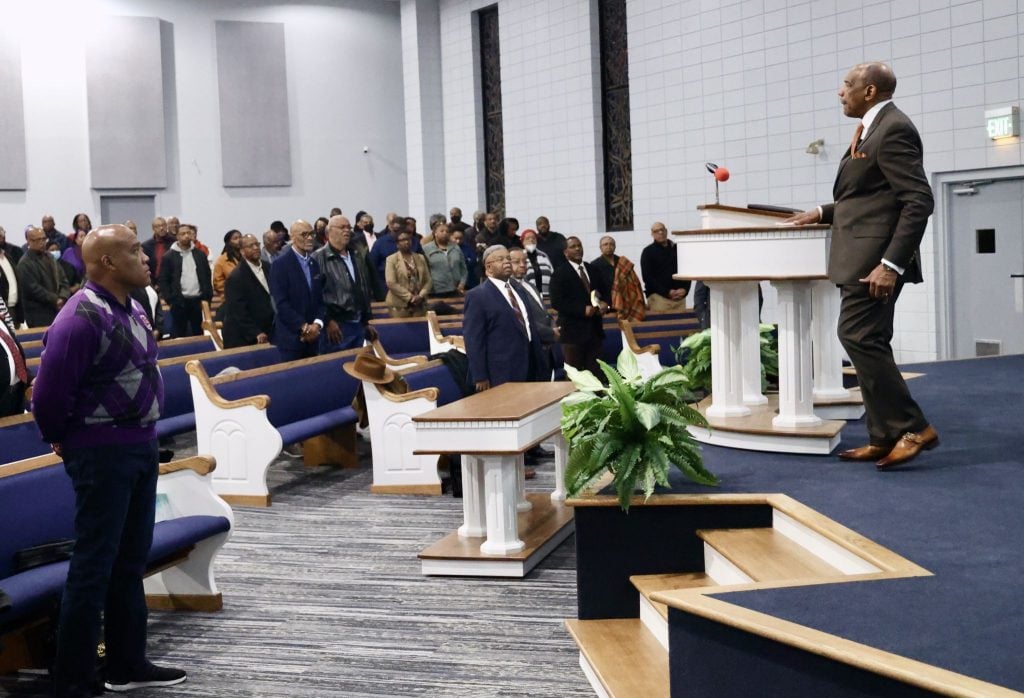
ATLANTA — Hundreds of Christians came to Atlanta seeking true…

|
Getting your Trinity Audio player ready...
|
The heartbeat of the American Restoration Movement is propelled by two core beliefs: First, that Jesus is serious about unity; and second, that true unity is found through submission to God’s will.
 Read more here.</a>" width="300" height="300" srcset="https://christianchronicle.org/wp-content/uploads/2026/01/who-are-we-final-300x300.png 300w, https://christianchronicle.org/wp-content/uploads/2026/01/who-are-we-final-1024x1024.png 1024w, https://christianchronicle.org/wp-content/uploads/2026/01/who-are-we-final-150x150.png 150w, https://christianchronicle.org/wp-content/uploads/2026/01/who-are-we-final-768x768.png 768w, https://christianchronicle.org/wp-content/uploads/2026/01/who-are-we-final-1536x1536.png 1536w, https://christianchronicle.org/wp-content/uploads/2026/01/who-are-we-final-600x600.png 600w, https://christianchronicle.org/wp-content/uploads/2026/01/who-are-we-final-2000x2000.png 2000w, https://christianchronicle.org/wp-content/uploads/2026/01/who-are-we-final.png 2048w" sizes="(max-width: 300px) 100vw, 300px" />
This is part of a series exploring the identity of Churches of Christ. Read more here.
As a new year dawns, The Christian Chronicle is launching a new series titled “Who Are We?”
We plan to explore key questions, challenges and, yes, opportunities facing Churches of Christ. At the beginning, we felt it important to highlight the principles that have driven generations of believers connected to the Restoration Movement and ask whether these principles still define us today.
These core principles were at work in August 1801 when ordained Presbyterian clergyman Barton W. Stone, along with other Presbyterian, Methodist and Baptist ministers, determined to forget their confessions and creeds and simply preach Christ to the 20,000 who gathered at Cane Ridge, Ky.
The same principles inspired Thomas Campbell to welcome believers from outside the Presbyterian faith to share communion, against the wishes of his overseeing synod. After joining his father on the American frontier, Alexander Campbell championed these convictions through an influential life of preaching, publication, education and public debate.
Related: ‘We don’t have to settle for divide’
And those same principles were behind a New Year’s Day handshake in 1832 between Racoon John Smith and Stone, merging the followers of Campbell’s and Stone’s efforts in their work toward unity, despite their differences.
Campbell, Stone and other leaders never desired to start a new church or their own denomination. Quite the opposite. People who shared their convictions came to be known as Churches of Christ, Christian Churches and Disciples of Christ — descriptions found in the Bible itself.

Barton W. Stone preached some of the core principles that would lead to the Restoration Movement at an 1801 revival at the Cane Ridge Meeting House in Kentucky.
Nearly 225 years after Cane Ridge, there is reason to question whether these two principles remain central to who we are.
Churches of Christ, Disciples of Christ and Christian Churches have branched off to become their own independent families. Among the Chronicle’s audience, unspoken fissures exist over questions of worship, gender roles and how we view people outside “Churches of Christ.” There is an implicit division over which colleges, conferences, ministries and ministers to support.
We have drifted increasingly close to becoming the very thing we once opposed, replacing written creeds with unwritten assumptions, statements of faith with blogs and publications, and denominational councils with lectureships and conferences. We’ve grown suspicious of one another.
All the while, Jesus’ prayer — “that they all may all be one” — continues to echo. Turns out, this work of restoration is an ongoing challenge.
“The beauty of the Restoration Movement is that it was never built on fidelity to Stone, the Campbells or any other besides Christ. Instead, it was built on the desire to simply be Christians.”
There is a tension between the work of unity and the commitment to Scripture. Sincere people have sincere differences about how Scripture speaks, the meaning of its silence and just what constitutes matters of faith and matters of liberty. The beauty of the Restoration Movement is that it was never built on fidelity to Stone, the Campbells or any other besides Christ. Instead, it was built on the desire to simply be Christians.
So who are we? At our best, we are committed to the unity for which Jesus prayed. We take Scripture seriously. And we live humbly within the tension.
We sense a spirit of restoration stirring within a new generation, and we prayerfully look forward to the opportunities to report on what God is doing in our time.
JEREMIE BELLER is opinions editor for The Christian Chronicle. He is dean of Bible and director of church relations for Oklahoma Christian University. He serves as the congregational minister for the Wilshire Church of Christ in Oklahoma City.
ATLANTA — Hundreds of Christians came to Atlanta seeking true…

In the “Who Are We?” series, The Christian Chronicle is…

Minister shortages. Closing churches. Struggling theology schools. All are happening…

For many people, history is boring, or there is no…

CHICAGO — To a visitor entering the Northwest Church of…
MEMPHIS, Tenn. — Every new year ushers in a sense…
Your donation helps us not only keep our quality of journalism high, but helps us continue to reach more people in the Churches of Christ community.