Cuba
Cuba

Faith sustains Cuban farmer during time of crisis
LIMONAR, CUBA — It’s a tough time for Christian farmer…

|
Getting your Trinity Audio player ready...
|
MATANZAS, CUBA — René Sánchez Blanco sailed eight hours on a ferry from the Isle of Youth to Cuba’s mainland and then spent five hours on buses.
Mario and Yani Suárez waited three days in line at a bus station in western Cuba. The couple slept in the terminal to buy tickets for an all-day, multi-stop journey.
Samuel Rondón Aguilar and his mother, Margarita, endured 24 hours on a train from eastern Cuba.
Cuba in crisis: Read all the stories in the special package
At a desperate time for this Caribbean island nation — crippled by severe fuel and food shortages, frequent power outages and rising tensions with the United States, its powerful neighbor 90 miles to the north — faith in Jesus brought together Cuban believers this week.
From all over the island — which stretches nearly 800 miles — Christians came to attend the fifth annual Missionary Congress in west-central Cuba. The five-day event celebrates church-planting efforts in the socialist nation of 9 million souls.
“It’s a horrible trip,” Samuel Aguilar, 24, said of the train ride from Rio Cauto in Cuba’s eastern province of Granma. “But it’s a huge blessing to be here with the brothers and sisters.”

More than 300 men, women and children fill the Versalles Church of Christ building in Matanzas, Cuba, during the national discipleship gathering.
The fuel crisis has disrupted the availability and affordability of gasoline for personal vehicles and limited the frequency and reliability of normal public transportation options.
Despite the challenges, more than 300 men, women and children filled the Versalles Church of Christ, about 60 miles east of Havana, on Saturday night and Sunday morning. A smaller group of leaders engaged in evangelistic training Monday, Tuesday and Wednesday.
The host congregation — which baptized 236 people in 2025 — meets in a government-authorized, open-air auditorium in Matanzas, the namesake capital of Cuba’s province of Matanzas.
Over the weekend, attendees sang, prayed and studied the Bible — and enjoyed time for fellowship with like-minded disciples experiencing the same societal troubles.
“We find spiritual nourishment here,” said Yani Suárez, 33, a mother of three who — like most of the Cubans interviewed for this story — spoke through a Spanish-language interpreter. “We find the fellowship. We find the love. And we just become renewed.
“At our home congregation, there’s just a few of us,” added Suárez, a minister’s wife in Cuba’s far western province of Pinar del Río. “It’s difficult, and at times it feels like we’re all alone. Here, we get to see other Christians, and we get to see that we’re not alone.”

Mario and Yani Suárez stand during worship at the Missionary Congress event in Matanzas, Cuba.
Even a week before the conference, organizer Tony Fernandez — the Versalles church’s longtime minister — doubted if he could pull it off.
“I was really worried, and my wife knew that I didn’t have everything that I needed to do this,” said Fernandez, who has helped plant more than 50 Cuban congregations. “But she’s got groups of women who pray every day starting at 5 a.m.
“And they prayed, and God works,” he added. “We were able to have transportation. We were able to get fuel.”

Tony Fernandez, far right, performs with the Matanzas chamber orchestra. The group presented a special concert for visiting Christians Sunday afternoon.
Besides his ministry work, Fernandez performs as a professional bass violinist with Matanzas’ chamber orchestra and fosters other deep ties in the community through his faith-based humanitarian endeavors. Local authorities applaud his efforts and help pave the way for the Versalles church’s special events.
Among those who made it to the Missionary Congress: 35 Christians from Colón, a Matanzas province town more than 50 miles away.
“How are you going to get here?” Fernandez asked.
The answer: The back of a cargo truck.
“They paid the driver,” the minister said, “but they’re here.”

Christians traveled from all over Cuba to attend the Missionary Congress event in Matanzas.
So far in 2026, U.S. President Donald Trump has launched military operations aimed at regime change in Venezuela and Iran.
Speculation mounts that Cuba’s 67-year-old Communist government — formed when the late Fidel Castro rose to power in this nation’s 1959 revolution — could be the next target.
Since the capture of Venezuelan President Nicolás Maduro on Jan. 3, the U.S. has blocked Cuba’s oil imports and paralyzed the island’s tourist industry. Canadian and European airlines halted flights to the island because of the inability to refuel.
For decades, Cuba has blamed U.S. sanctions for its economic problems, while the U.S. cites its aim to restore democracy and respect for human rights.
The U.S.-imposed blockade since the Venezuela attack has put a stranglehold on daily life in Cuba.

Minister Tony Fernandez, left, baptizes new souls into Christ nearly every Lord’s Day. Six came forward to be baptized during this week’s Sunday morning assembly.
“We’ve never been through anything like this,” said Fernandez, 53, who as a child worshiped God discreetly with his parents when Castro imposed severe restrictions on churches.
Still, the minister praises God.
“We live the Christian life as an adventure of faith,” he said.
“We live the Christian life as an adventure of faith.”
Liudmila Barrizonte, a 52-year-old former English professor, worships with the Suárezes in Pinar del Río. She joined them at the Missionary Congress.
“It’s very difficult,” Barrizonte said of Cubans’ circumstances. “Everything is very expensive, like 10, 12, 15 or 100 times more expensive than before.”
But the Lord has a way of providing, she stressed.
Related: Faith sustains Cuban farmer during time of crisis
“God multiplies the bread and the fish every day for the Cubans,” Barrizonte said, referring to the biblical accounts of Jesus feeding 5,000 with five loaves and two fish.
“When you tell people that most of us survive with less than $10 a month, they don’t believe it, but we do,” she added. “It has to be God’s work. There’s no other explanation for me.”

Liudmila Barrizonte, left, visits with visiting American Christians Rick Elam and Mike Kellett at the home of Jorge Sanchez, who manages the church’s farm south of Matanzas.
A dozen Christians from six U.S. states flew to Cuba for the Missionary Congress. Given the island’s proximity to Florida, refueling is not a concern for U.S. airlines.
Chase Turner, president and CEO of Herald of Truth, which focuses on empowering Spanish-speaking works in Cuba, Honduras and the U.S., preached at the event Saturday night.
Mike Kellett, senior minister for the White’s Ferry Road Church of Christ in West Monroe, La., and co-director of its One Kingdom global ministry, gave two sermons Sunday morning.
“It’s just great to know that you’ve got brothers and sisters all around the world, and it’s encouraging to see them have such hope and such great spirits about them in the middle of their poverty,” Kellett told The Christian Chronicle.
Herald of Truth and One Kingdom — in partnership with Illinois-based Hope and Equip — provided food for the conference and funds for roof repairs for the Versalles church. In addition, the ministries gave away free Spanish-language Bibles and bought motorcycles for a few Cuban preachers.
“We want to encourage the people here and also provide what they need from a financial standpoint,” said Turner, a member of the White’s Ferry Road church.

Chase Turner, president and CEO of Herald of Truth, preaches during the Missionary Congress event.
Some Cuban preachers lead as many as eight worship services each Lord’s Day, Fernandez said, and need a reliable means of transportation from congregation to congregation.
“But then during the week, they can use the motorcycle as a taxi,” he explained. “Especially now when many buses aren’t running, that’s really needed.”
Other conference speakers included Tim Archer, minister for the Alvarado Church of Christ in Texas and director of development for the Texas International Bible Institute; and Jimmy Pinzón, who lives in Alabama and focuses on ministry outreach to Colombia.
Archer, a former missionary to Argentina, worked for Herald of Truth for two decades.
He has made 48 mission trips to Cuba.
On his latest one, an eerie quietness greeted him in Matanzas — a normally bustling city of roughly 150,000 people.
“It’s sad to see the lack of cars or buses,” Archer said. “Normally, there’s heavy traffic. It’s a big city, and right now, about all you see are a few motorcycles around — and a lot of those are electric motorcycles because there’s just no gas.

Residents walk along a Matanzas, Cuba, street during the U.S. mission group’s recent trip.
“There’s more trash around, too,” he added. “I think the trash trucks aren’t able to run as much.”
Yet Fernandez — Archer’s brother in Christ and longtime friend — approaches the difficulties with optimism and deep faith, the Texas minister said.
“I know that he hurts for people, and he is having to do so much,” Archer said, noting that the Versalles church feeds members every Sunday because otherwise “they’ll faint on the way home because they don’t have anything to eat.”
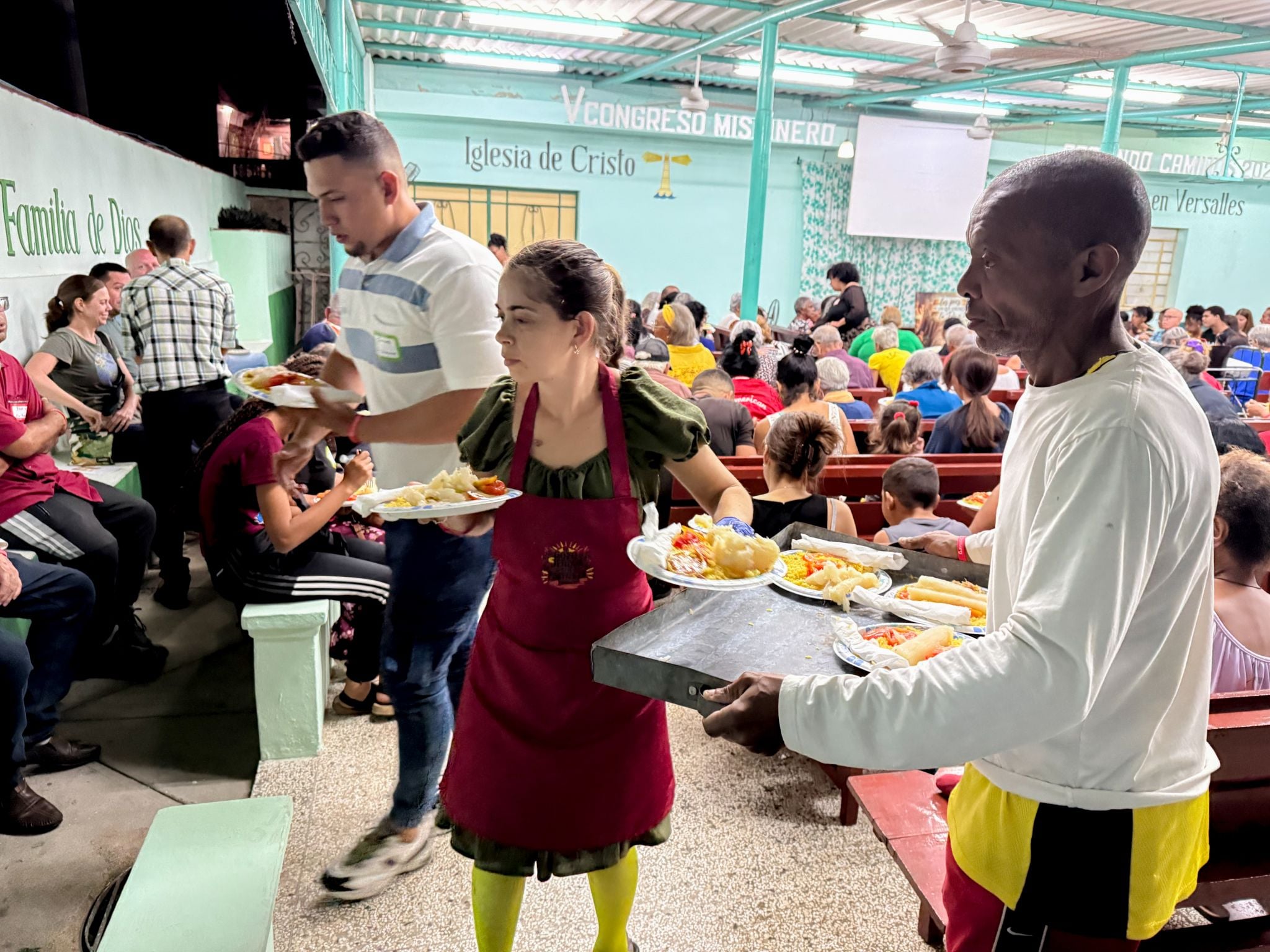
The Versalles Church of Christ in Matanzas, Cuba, feeds the crowd during the Missionary Congress event.
From a desire for fellowship to the opportunity for outreach instruction, all the Christians who traveled to Matanzas had personal reasons for doing so.
What motivated the Aguilars to tolerate a grueling train ride?
Flooding after Hurricane Melissa ravaged the family’s hometown.
The son and mother came to thank Fernandez and other believers who helped in the storm’s aftermath.
“There were families who lost everything,” Samuel Aguilar said.
Samuel and his father, Arsenio, who is undergoing kidney dialysis and couldn’t make the trip, work with three small congregations and share preaching duties.
Related: ‘Cuban people love the American people’
After the October hurricane, Fernandez drove to Rio Cauto and offered food, money and spiritual support.
“Because of the way the church helped out there, 22 people were baptized,” Samuel said. “So that’s a huge motivation for us to keep working and keep preaching because of all of these people that came to Jesus.”

Samuel Rondón Aguilar, right, thanks fellow Christians for their help after Hurricane Melissa. Also pictured, from left, are Esmailys Pamayo Leyva, Margarita Aguilar and Mairín Méndez Sánchez.
While in Rio Cauto, Fernandez noticed victims trying to dry out mattresses soaked in river water.
“That’s impossible,” Fernandez thought to himself.
So at the Missionary Congress, the Versalles minister presented the Aguilars and a couple who came with them from Rio Cauto with new mattresses. The Central Church of Christ in Sparta, Tenn., donated the items.
“It’s not just for us,” Samuel said of the gift. “There are other brothers and sisters who lost their mattresses, and we’re going to be able to help them.”
After arriving in Matanzas, the Aguilars learned their planned return train was being canceled, said Candice Pinzón, who has made a half-dozen mission trips to Cuba with her husband, Jimmy.
Pinzón said the faith and resiliency of the island’s Christians inspire her.
“They travel without the security of knowing how they’re going to get back home or the food along the way,” she said. “But they come anyway.”

Christians pray during the Lord’s Supper at the Missionary Congress event.
Blanco, who came to Matanzas via the ferry and buses, preaches on Cuba’s Isle of Youth.
Before converting to the Church of Christ, the 76-year-old minister practiced Santería, a fusion of African religions and Catholicism.
But in 1990, he faced mounting problems in his life. So he decided, he said, to flip open his Bible and do what it told him.
“I opened it to Psalm 115, and it told me to get rid of my idols,” Blanco said.
He did just that and was baptized.
Since then, he has started three congregations on the Isle of Youth. Their combined membership totals 300, including many who came from the Santería faith.

René Sánchez Blanco leads a prayer during the Missionary Congress event.
“I really like to be with the other brothers and sisters and have a chance to preach to people,” Blanco said of why he came to the Missionary Congress.
As for Cuba right now, he points to Exodus 14:14: “The Lord will fight for you; you only need to be still.”
“Everything’s hard,” Blanco said, “but we trust in God.”
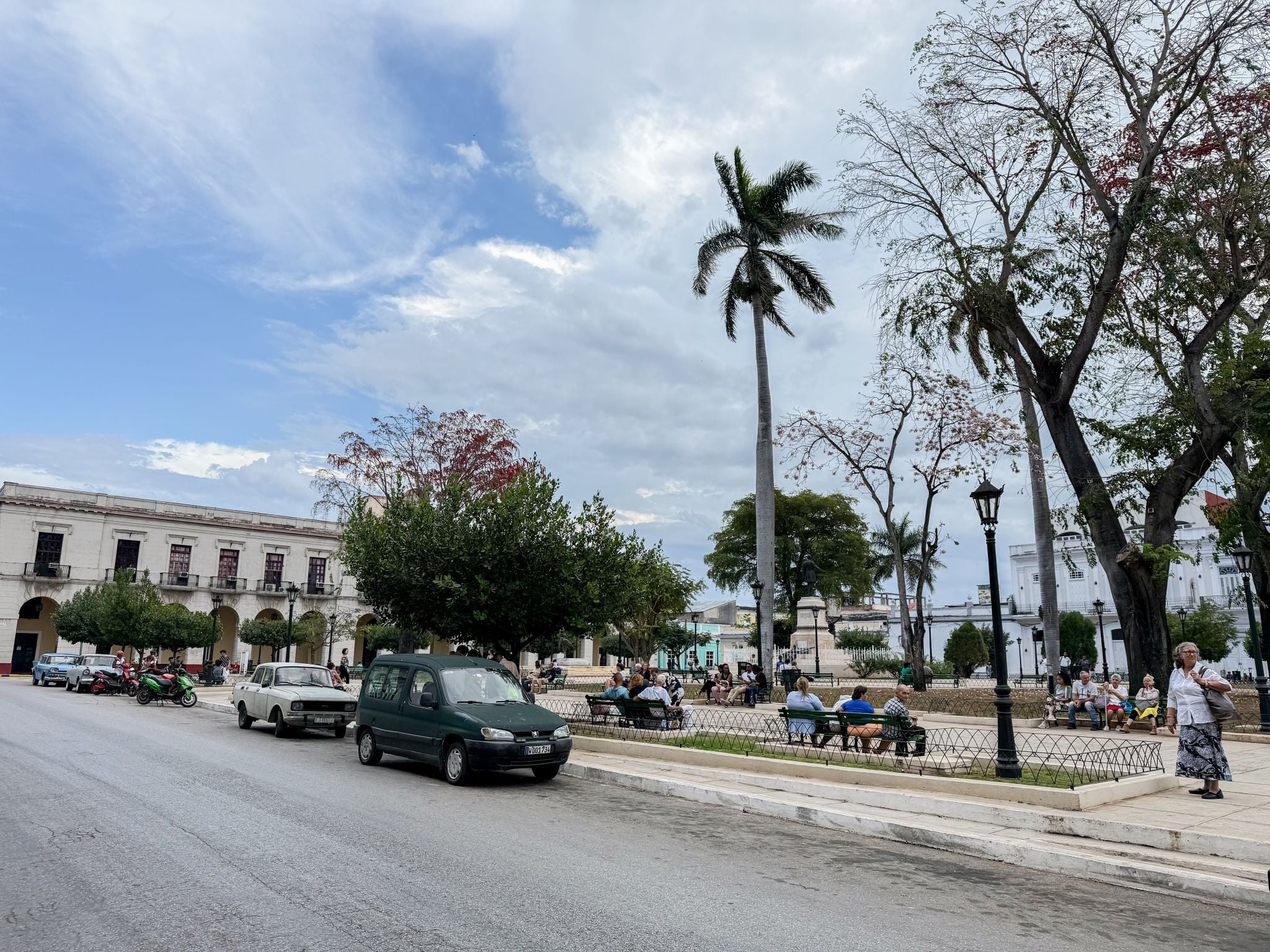
The town square in Matanzas, Cuba.
BOBBY ROSS JR. is Editor-in-Chief of The Christian Chronicle. He traveled to Cuba to report this story. Reach him at [email protected].
LIMONAR, CUBA — It’s a tough time for Christian farmer…

MATANZAS, CUBA — This might seem like a bad time…

MATANZAS, Cuba — Church members in this port city overlooking the…

Fear mixed with hope. That’s how Christians from the Middle…

WESTON, FLA. — One worked for a multinational tech company.…

MATANZAS, Cuba — I crouched in anticipation as I stared…
Your donation helps us not only keep our quality of journalism high, but helps us continue to reach more people in the Churches of Christ community.