
Editorial: Why the restoration plea is still valid
Minister shortages. Closing churches. Struggling theology schools. All are happening…

|
Getting your Trinity Audio player ready...
|
For many people, history is boring, or there is no perceived benefit to studying about people who might as well be from outer space due to cultural differences.
Unfortunately, Churches of Christ tend to be ahistorical, making it challenging for young people and adults in the Churches of Christ to appreciate their history.

Luke Dockery and Jared Pack. “Origin Story: Churches of Christ and the Restoration Movement.” Deeper Youth Ministry. 2025. 115 pages. $12.99.
But in “Origin Story: Churches of Christ and the Restoration Movement,” Luke Dockery and Jared Pack have combined their decades of experience in youth ministry and teaching to create a fun and entertaining way to learn the history of the Restoration Movement — comic book style.
What is our origin story? The authors believe that knowing our history is essential to understanding who we are. Their purpose in writing this book is to ensure that young people understand the Restoration Movement plea and to encourage them to follow it in their own lives.
Barton Stone and Thomas Campbell advocated for a unity among Christians that would center around “no creeds, but the Bible” only. Alexander Campbell encouraged the restoration of “the ancient order of things.”
But the “Origin Story” authors believe that churches descended from Stone and Campbell’s Restoration Movement — including modern Churches of Christ — have traded their original plea for either a sectarian or denominational view.
This was not the way that our spiritual forefathers thought. So, Dockery and Pack set out to show that movement leaders sought unity among people who wanted to be “Christians only” while intentionally following the Bible only.
Related: Editorial: Why the restoration plea is still valid
They are honest about how unity and restoration are in tension with one another in the life of a Christian; however, that should never stop one from seeking to live in balance with these two biblical ideas.
Due to the struggle between the two ideas, the Restoration Movement has consistently favored one over the other throughout its history. The results have not always been pretty, but the authors do not shy away from the unpleasant aspects of the movement, such as the presence of controversial figures or issues like segregation.
This is one of the book’s most important features: We must learn from the past, so that the right plea can be taken up again.
Also important is the book’s examination of the Restoration Movement within the broader context of church history. Churches of Christ will often start in the first century and then skip to 19th century America. But this book reminds the reader that historical events and movements do not happen in a vacuum.
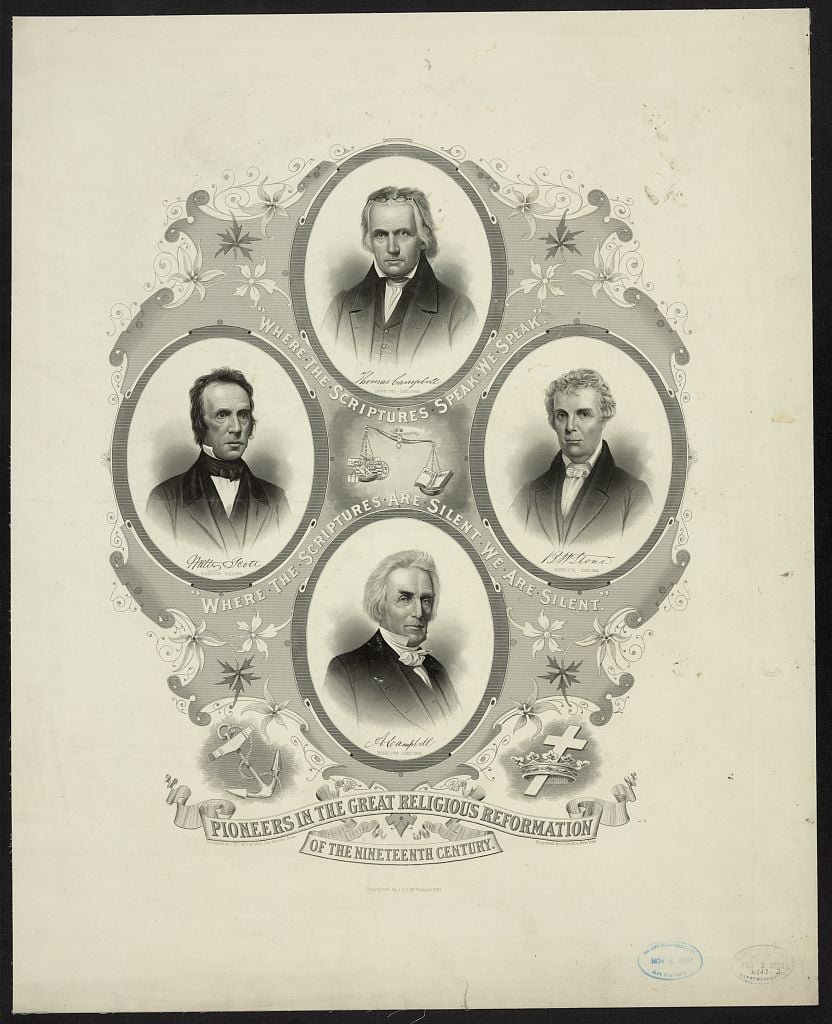
A 19th century print depicts leaders of the Restoration Movement: Clockwise from top, Thomas Campbell, Barton Stone, Alexander Campbell and Walter Scott.
This book is written and designed with young people in mind. But it can also be used for an adult Bible class or personal study for adults who want to learn more about their spiritual heritage and identity.
I am very thankful for Dockery and Pack and for this project. I hope that our fellowship supports this work not only because it is presented in an entertaining format, but also because it will help reshape Churches of Christ in the way of the true restoration plea.
ZACK MARTIN is an instructor of historical theology and dean of students at Heritage Christian University in Florence, Ala.
As an Amazon Associate, we earn money from qualifying purchases made through the links on this page.
Minister shortages. Closing churches. Struggling theology schools. All are happening…

ABILENE, TEXAS — One theme in my recently published book,…

To echo Edward J. Robinson in the foreword, John Young…

If you are looking for a book of hope during…

NORTH LAS VEGAS, NEV. — A motto commonly associated with…

FALLS CHURCH, VA. — The Church of Christ in this…
Your donation helps us not only keep our quality of journalism high, but helps us continue to reach more people in the Churches of Christ community.