
Special project: Where have all the churches gone?
Introduction • Where have all the churches gone?: Christian Chronicle…

|
Getting your Trinity Audio player ready...
|
Are Churches of Christ declining in the United States?
“That’s probably true,” said David Kneip, “but the evidence is largely anecdotal. We hear more about churches closing than opening, more about combining staff positions than expanding, but it’s hard to know what is real and what is fear or anecdotal.” Kneip is associate director of the Siburt Institute at Abilene Christian University in Texas

David Kneip
To separate truth from rumors, the newly formed Church Research Council seeks to provide an accurate picture of the fellowship in the U.S. and trends across congregations, regionally and nationwide.
The nonprofit combines the resources of 21st Century Christian, Heritage21, the Siburt Institute for Church Ministry and The Christian Chronicle.
Unlike various denominational groups in the U.S., Churches of Christ function autonomously and have no headquarters or governing body. Church leaders traditionally have believed that autonomy mirrors the practices of first century churches portrayed in Scripture. However, Kneip said, this complicates the collection of data necessary to understand what is happening among congregations.
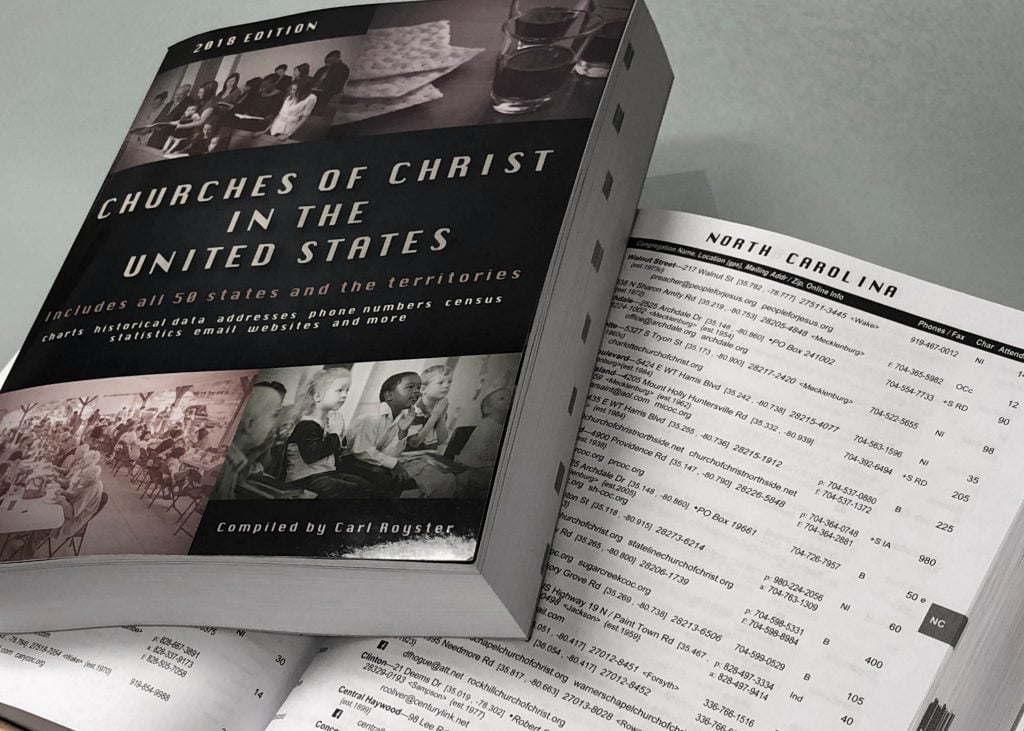
For the past five decades, the most accurate tool for assessing growth and decline in the fellowship was the directory “Churches of Christ in the United States,” originally published by Firm Foundation Publishing as “Where the Saints Meet.” Erik Tryggestad, president and CEO of The Christian Chronicle, has kept a copy of the directory on his desk, next to his Bible, since he began working for the newspaper in 2001. He jokingly refers to it as “The Lamb’s Book of Life.”
Related: Special project: Where have all the churches gone?
“We’ve heard the often-quoted stats that, in the 1950s and 1960s, we were the fastest growing faith group in the U.S.,” Tryggestad said. “Then came Mac Lynn, who did research and dispelled that myth. Churches of Christ indeed grew rapidly up until the late 1980s, but not at the rate many of us thought.”
Lynn, a longtime professor at Lipscomb University in Nashville, Tenn., was the directory’s first editor. He passed that duty to Carl Royster of 21st Century Christian in 2006. The company produced a print edition of the directory every three years until 2018. The COVID-19 pandemic halted future editions.

Carl Royster
By combining 21st Century Christian’s resources with those of the other three organizations, the directory will become “something far better than it’s ever been,” Royster said.
The Church Research Council launched a website to collect data from congregations. Researchers encourage participation from congregations across the progressive/conservative spectrum of the fellowship, including groups such as one-cup congregations and non-institutional Churches of Christ. Researchers hope their efforts will reflect the broad cultural, racial and language diversity among U.S. congregations.
Stan Granberg, a founder and board member of Heritage21, coordinates the research council’s efforts and has contacted representatives of the major streams within the fellowship to encourage participation and buy-in.
Royster hopes all Churches of Christ in the U.S., regardless of size, will participate.
“Too often people think, ‘We’re just one little congregation. People don’t care about us,’” he said. “But one person reporting from a congregation of 20 is just as important as someone reporting from a congregation of 2,000.”
TO PARTICIPATE, or for more information, see 21stcc.com/ccusa.
Introduction • Where have all the churches gone?: Christian Chronicle…

LOUISVILLE, Ky. — What’s the oldest Church of Christ in America?…

NORTH LITTLE ROCK, Ark. — On a recent Sunday morning,…

LOS ANGELES — At age 13 in 1983, I moved…
When asked about their concerns for the future of the…

Where do Churches of Christ go from here? A panel…
Your donation helps us not only keep our quality of journalism high, but helps us continue to reach more people in the Churches of Christ community.