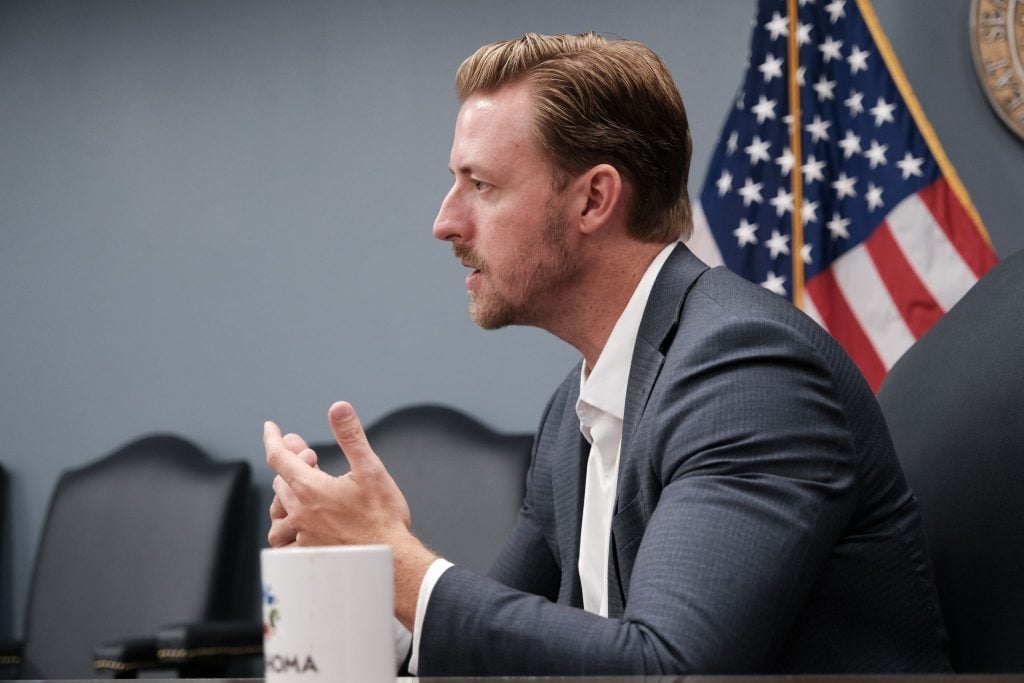
Culture warrior, MAGA champion, Church of Christ member: Who is Ryan Walters?
OKLAHOMA CITY — Ryan Walters wasn’t always known as Oklahoma’s…

|
Getting your Trinity Audio player ready...
|
Vouchers. Education savings accounts, known as ESAs. Tax credits. Tax credit ESAs. Trusts. Scholarships.
A lot of legislation has accumulated under the umbrella that opponents refer to as school vouchers and proponents call school choice.
Many leaders in K-12 schools associated with Churches of Christ advocate for programs that help parents afford tuition at a private Christian school in an environment consistent with their family’s values.
Related: Special project: Reading, ‘riting … religion
Meanwhile, Christians laboring in public education, particularly in rural areas, believe the commensurate loss of essential funding to public schools would undermine their own service to children of all backgrounds and abilities, diminish communities and reduce funding essential to educating the nation’s workforce.
In all, 29 states have some sort of state-funded, private school choice available to families, according to Education Week. Some are universal, meaning any child is eligible. Others are limited to students in certain counties, or with disabilities, or from low-performing school districts.

Students at Harding Academy in Searcy, Ark., visit their lockers between classes.
However they’re structured and named, the programs are designed to accomplish one goal: to provide public funds to parents who want their children to attend a private school. The idea is not new, and its history is not pretty. In some Southern states, the earliest voucher legislation was crafted in the 1950s as a hedge against racial integration.
Today the racial argument has flipped, with proponents in inner cities arguing that access to private education is a lifeline for minority students in failing public schools. Research on the question seldom provides an apples-to-apples comparison.
Just 11 leaders of Christian schools in five states responded when The Christian Chronicle surveyed administrators about vouchers and their impact. None suggested campus diversity has increased, but some have seen an increase in enrollment.
Seven administrators said they favored vouchers and related programs. Two opposed. Two remained uncertain.

Jay Burcham
Jay Burcham, president of Brentwood Christian School in Austin, Texas, opposes vouchers but supports ESAs.
“Direct payment from the government comes with strings. We will not accept direct payments,” Burcham said. “I do support ESAs, which let parents decide where their kids go to school, and then the parent pays the school from that account.”
But he said, “Brentwood Christian will never sacrifice its Christ-centered mission for the sake of expanded enrollment opportunities.” This year, the school has 687 students.
Trent Williamson, head of school at Harding Academy in Memphis, Tenn., said his school has benefited from ESAs, which are only available in counties encompassing Memphis, Nashville and Chattanooga and to low-performing districts statewide. Williamson hopes Tennessee will adopt a universal choice program.
“If parents are the primary educators of their children … then they should be empowered to use their educational dollars in the environment that best suits the learning needs of their children.”
About 80 of the school’s 700 students receive an ESA, and he credits growth over the past three years to the program.
“If parents are the primary educators of their children, and we believe that they are,” Williamson said, “then they should be empowered to use their educational dollars in the environment that best suits the learning needs of their children.”
Administrators from several states declined to reply on the record. That reticence and the number who did not respond at all despite repeated attempts may speak to the political animus surrounding vouchers.

Andrew Baker
“All eyes are on Texas,” said Andrew Baker, president of the National Christian School Association, which he has led since 2022. Now based at Harding University in Searcy, Ark., NCSA previously was housed at Oklahoma Christian University and Abilene Christian University in Texas.
NCSA serves as the accrediting body for about 60 K-12 schools associated with Churches of Christ in 20-plus states, Baker said. The largest number of schools are in Tennessee and Texas.
In Texas, the 2023 regular legislative session and four special sessions ended with Republican Gov. Greg Abbott refusing to release approved funding for public schools after the House failed to pass an education bill that included vouchers.
The stalemate left inaccessible $4.3 billion budgeted for public education — dollars that would have provided the first teacher pay raises since 2019 among other things.
Twenty-one Republicans, mostly from rural districts, joined 63 Democrats to defeat the legislation.
Abbott responded by raising funds from voucher supporters, including oil billionaires in West Texas and a TikTok billionaire from Pennsylvania, to defeat the GOP legislators who opposed him.
Rep. Stan Lambert, a member of University Church of Christ in Abilene, was one of only three House members who survived against primary opponents funded by Abbott allies. Lambert served 10 years as president of the Abilene School Board before running for the House seat in 2016.
Rep. Travis Clardy, a member of the North Street Church of Christ in Nacogdoches in deep East Texas, also opposed vouchers. Targeted by Abbott, he lost his seat. Rep. Cecil Bell, a member of the Magnolia Church of Christ, northwest of Houston, supported the voucher plan.
For Lubbock Christian University graduate Bric Turner, the issue is personal, political and perilous. He serves as the superintendent for the tiny Meadow Independent School District, which has just 230 students.
Located 19 miles southwest of Lubbock, the property-poor Meadow district competes with Lubbock for teachers and staff while paying teachers thousands of dollars less. Local property taxes provide the majority of education funding for Texas school districts.
“Is the goal to get rid of 1A schools?” Turner said, referring to the smallest schools in Texas. “I don’t know how that’s not the goal because you cannot operate schools without money.
“It is small-town Texas that the government and the governor have chosen to attack. This has nothing to do with Christianity. It’s about money and politics.”
“Public schools are representative of society — we have a little of everything, not just in students but in teachers or employees,” he added. “We still pray before our board meetings and football games. We do that because those are small-town Texas values, and it is small-town Texas that the government and the governor have chosen to attack. This has nothing to do with Christianity. It’s about money and politics.”
Shelly Huddleston’s husband, Kevin, served as youth minister for the Johnston Street Church of Christ in San Angelo, Texas, for 30 years, so for her, “public education was a great outcropping of ministry.”
Huddleston, district chief of school leadership in San Angelo, feels the daily impact of the Capitol drama: “We’re 21 teachers down at the start of school and 47 support staff down. … We’re struggling to keep the air-conditioning going in terrible heat, but we don’t have AC maintenance because they’ve left to make more money.”
Related: Culture warrior, MAGA champion, Church of Christ member: Who is Ryan Walters?
She said many rural legislators voted against vouchers because few, if any, private school options exist in those communities.
“So it’s less funding for us, but we’re still going to have the kids,” Huddleston said. “Funding we really need is being diverted to other places.”
Though she’s worked in public education for 29 years, she attended a Christian school while growing up in California. And while she supports the idea of Christian education, she is concerned private schools don’t have the same standards of accountability in return for state funding that are imposed on public schools, especially for kids with special needs or disabilities.
“At the end of the day, I still believe the more people who can benefit from and participate in faith-based education grounded in the person of Jesus, the better.”
NCSA’s Baker said “the reality is you can make both arguments and make them pretty firmly,” regarding accountability and special education programs. He said Christian schools are making efforts regarding special ed, but “we’re not there yet.” And he believes schools should be accountable.
“A private Christian educator should have no hesitation for people to look at the quality of education,” Baker said. “But at the end of the day, I still believe the more people who can benefit from and participate in faith-based education grounded in the person of Jesus, the better.”
NCSA doesn’t get into the politics of legislation.
“From our seat, we’re just trying to help schools make the best decision for their school,” Baker said.

Jim Gurchiek is the superintendent of Harding Academy in Searcy, Ark.
Jim Gurchiek, superintendent of Harding Academy in Searcy, Ark., said his school’s enrollment has increased about 10 percent directly from the Education Freedom Account — a centerpiece of Gov. Sarah Huckabee Sanders’ LEARNS Act.
“We have enrolled many students that were previously homeschooled,” Gurchiek explained. He expects more growth in 2025-26 when all Arkansas residents are eligible to apply for EFAs.
Annual tuition, books and fees at the Searcy school ranges from about $8,000 for kindergarten to close to $12,000 for senior high. Of 699 students enrolled this year, 300 benefit from LEARNS Act funds, which can be up to 90 percent of what the state spends per pupil in public education, currently about $6,800.
“It takes so many of us doing tiny little things to make a difference in our students’ lives. Especially now that my husband is no longer in ministry, I feel even more strongly that this is my calling from God.”
Jenny Woodard Petty, English as a Second Language and migrant program coordinator for one of the districts serving Jonesboro, Ark., also has a Christian school background. She previously taught at Crowley’s Ridge Academy in Paragould, Ark. But she has found a personal ministry in public education.
“It takes so many of us doing tiny little things to make a difference in our students’ lives,” Petty said. “Especially now that my husband is no longer in ministry, I feel even more strongly that this is my calling from God.”
And she opposes vouchers.

Jenny Petty sits on the steps of Compass Church in Jonesboro, Ark.
“I’m against them. … I loved where I worked and our mission and values. But I don’t think it’s appropriate to take money for public schools and give it to families like that,” the teacher said.
Petty was a leader in a statewide grassroots effort by educators that began on social media and led to hundreds of teachers going to the state Capitol in Little Rock to testify before the House Education Committee.
“Teachers spoke for nine hours against it,” Petty said. “But … our legislators weren’t even listening to us about our concerns.”
Related: Culture wars turn classrooms into battlefields
Since then, experienced educators have quit, and districts struggle with teacher shortages, she said.
She fears the big losers will be students most at risk.
“I love Christian education,” she said, “but I’m also a proponent for making sure those most at risk, like English learners and migrants, have education as well.”
The legal validity of vouchers, or the lack of it, rises from both federal and state constitutional questions. Education is left to the states, but the First Amendment guarantees that “Congress shall make no law respecting an establishment of religion, or prohibiting the free exercise thereof.”
Both the Establishment Clause and the Free Exercise Clause come into play, according to constitutional scholar Kenneth Pybus, professor and chair of the Journalism and Mass Communication Department at ACU.
“Since 2010, it’s been more likely for the court to have a more lenient view of what the Establishment Clause would allow,” Pybus said. Thus subsequent decisions “have been more about how the money is getting to the private school, less about whether the money was getting to them.”
“Just because they’re neutral, they are not hostile. Many people have confused hostility with neutrality, and sometimes it’s a self-inflicted wound.”
Curtis Culwell served as superintendent of the 59,000-student Garland Independent School District, in a suburb of Dallas, for 14 years before retiring in 2014. His family attends The Branch Church of Christ.
After 38 years in public education, Culwell — who wrote his doctoral dissertation about vouchers — said public schools have always been “about religious freedom and Christians not being subjugated to some type of state or sectarian religious principles.”
“And many schools are working hard at that. Just because they’re neutral, they are not hostile,” he added. “Many people have confused hostility with neutrality, and sometimes it’s a self-inflicted wound.”

Elementary students at Harding Academy in Searcy, Ark., do classwork.
Private schools don’t have to be neutral. Gurchiek said the students at Harding Academy Memphis openly honor and praise God every day.
“In public schools, teachers cannot initiate that,” he noted. “We are able to initiate that, and some parents prefer that for their children.”
Huddleston, the San Angelo administrator, thinks honoring God is important, too.
“Public schools are about all kids — taking in all kids. And that, to me, is what the message of Jesus is. Everyone is welcome.”
But she finds meaning in welcoming students to the neutral environment offered through public education.
“Public schools are about all kids — taking in all kids,” she said. “And that, to me, is what the message of Jesus is. Everyone is welcome.”
CHERYL MANN BACON is a Christian Chronicle contributing editor who served for 20 years as chair of the Department of Journalism and Mass Communication at Abilene Christian University. Contact [email protected].
OKLAHOMA CITY — Ryan Walters wasn’t always known as Oklahoma’s…

OKLAHOMA CITY — Before I got my start in religion reporting…

BRENTWOOD, TENN. — We are in the final few months…

BRISBANE, AUSTRALIA — The well-being team at Redlands College paused while…

HITACHI, JAPAN — I was 12 years old when I…
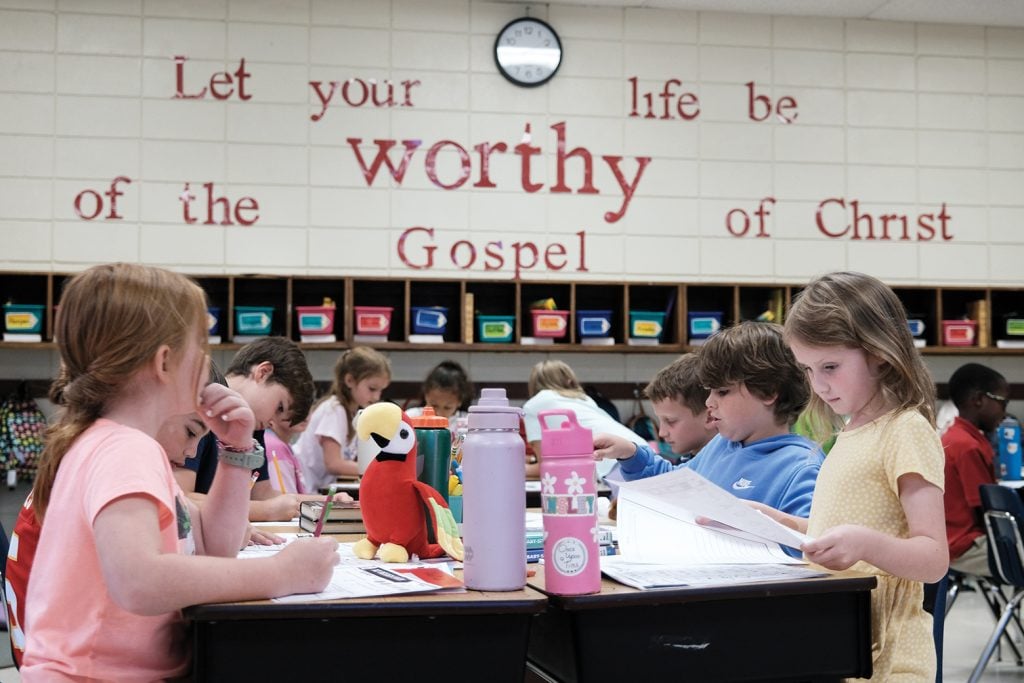
Find links to all the articles in the "Reading, 'riting…
Your donation helps us not only keep our quality of journalism high, but helps us continue to reach more people in the Churches of Christ community.