Oklahoma

A miracle in my family — it’s time to tell the story
ATOKA, OKLA. — To Tod Dillard, COVID-19 was no big…

|
Getting your Trinity Audio player ready...
|
OKLAHOMA CITY — To quote Will Ferrell’s character in the original “Anchorman” movie, “Boy, that escalated quickly. I mean, that really got out of hand fast.”
The fictional news anchor Ron Burgundy’s words seem fitting when reflecting back on the COVID-19 pandemic, which became real to most Americans five years ago this week.
By the time March got rolling in 2020, the phrase “coronavirus outbreak” already had entered the nation’s lexicon.

This week marks five years since the U.S. government declared the COVID-19 pandemic a national emergency.
In a March 5 story that year, The Associated Press’ David Crary wrote:
NEW YORK — A rising number of churches across the United States are making changes in response to the coronavirus outbreak, including a decision by numerous Catholic dioceses to suspend the serving of wine during Communion.
Thus far, there have been relatively few cancellations of worship services. However, Jamie Aten, a psychologist who is executive director of the Humanitarian Disaster Institute at Wheaton College, said it would be wise for faith leaders to start preparing for that eventuality.
Interestingly, the term “COVID-19” does not appear in that report, nor in a New York Times piece a few days earlier that delved into “Worship in the Age of the Coronavirus.”
Related: A miracle in my family — it’s time to tell the story
Although the World Health Organization had designated that official name in February 2020 for the disease caused by SARS-CoV-2 (severe acute respiratory syndrome coronavirus 2), the news media and ordinary people hadn’t adopted the official shorthand yet.
In my Weekend Plug-in column on March 6, 2020, I quipped, “Wash your hands before reading the rest of this.” Then I linked to a variety of faith-related stories about what I, too, labeled the “coronavirus outbreak.”
That same weekend, I got on an airplane — with no mask required — and flew to Nashville to cover the aftermath of deadly tornadoes that ravaged Middle Tennessee.
In hard-hit Cookeville, about 80 miles east of Nashville, I ate dinner upon arrival at a crowded Golden Corral buffet. Again, no mask required.
Certainly, all of us were talking by that time about what became known as COVID-19. However, I don’t know that many of us were overly concerned about it.
My family’s first real inkling that the mysterious virus might actually threaten our community — perhaps even one of us — came a few days after I returned home to Oklahoma City from Tennessee.
On March 11, 2020, my adult sons, Brady and Keaton, who are huge Oklahoma City Thunder fans, headed downtown to see a game.
“I remember driving down to the arena and being surprised at how cheap the tickets were going for,” said Keaton, then a senior journalism major at Oklahoma Christian University and now an investigative reporter for Oklahoma Watch.
Related: Lessons amid pandemic loss
“We bought some a few rows from the court for $40 each, and I said something to the effect of, ‘Thank you, coronavirus,’” he recalled. “That was pretty stupid in hindsight.”
Indeed, but we all had a lot to learn back then.
“Everything felt pretty normal leading up to the tipoff time,” Keaton recalled. “When the game didn’t start, I knew something was off. The arena message that the game was postponed wasn’t surprising, but it was the eeriest experience of my life. Everyone filtered out (of the arena) in a strange panic.”

Brady Ross, right, is a huge Oklahoma City Thunder fan. He’s pictured at a game with his father, Bobby; sister, Kendall; and son, Bennett.
Brady, president and founder of Clear Path Leadership, has a similar recollection.
“Hearing the public address announcer say the game was postponed and immediately follow it up with the ‘You are all safe’ line felt like something out of a movie,” he said. “As we’re walking out, a little boy is hanging on one of the guardrails on the stairs, and his father tells him not to touch it, which felt like a sign of things to come.”
As Brady and Keaton returned to the parking lot, news broke that Utah Jazz center Rudy Gobert had tested positive for the coronavirus, and NBA Commissioner Adam Silver decided to cancel the team’s game against the Thunder. The NBA then suspended its season “until further notice.”
Keaton and his girlfriend (now wife), Paige, discussed whether he might need to quarantine.
“I decided I wasn’t close enough to any of the Jazz players to catch it,” Keaton said.
Around that same time, Pepperdine University in Malibu, Calif. — where my daughter, Kendall, was a junior — announced a move to remote classes. The university gave students until March 15, 2020, to move out of campus housing.
Kendall, who had just returned to Southern California after a spring break trip to France and Spain, packed her belongings and made the 1,400-mile drive home to Oklahoma City with a friend.
What a crazy time!
On March 13, 2020 — five years ago this past Thursday — the U.S. government declared the “very contagious” virus, as President Donald Trump described it, a national emergency.
In my Weekend Plug-in column, I made the same joke as the previous week about washing hands before reading (I’m dependable like that).
Then I added, “This is one of those stories that seems to be, um, spreading faster than I can hyperlink URLs.”
Related: Surviving a pandemic
By that weekend, houses of worship were canceling services in droves, and many would not meet again in person for months.
Among the headlines I highlighted that Friday:
• “Why do worship services involve so many germs?” by the Deseret News’ Kelsey Dallas, who referenced “the global outbreak of COVID-19.”
• “With coronavirus concerns, sales up for prepackaged Communion cups and wafers” by Religion News Service’s Adelle M. Banks.
• “The Georgetown church quarantined by D.C.’s coronavirus outbreak” by the Washington Post’s Michelle Boorstein, who noted that the congregation’s rector became Washington’s first confirmed COVID-19 case.
Yes, at that point, individual infections were considered newsworthy.
By the end of March 2020, I wrote a reflective column in which I cited an AP story that reported the coronavirus outbreak could kill 100,000 to 200,000 Americans — a toll I found difficult to fathom.
Ultimately, COVID-19 claimed at least 1.2 million lives in the United States, according to the Centers for Disease Control and Infection.
Ultimately, COVID-19 claimed at least 1.2 million lives in the United States.
Early on, some started asking crazy questions like, “Should we let older Americans die or save the economy?” That would not be the last insane rhetoric related to the pandemic.
The invisible killer remained big news for weeks, months and even years.

Students, faculty and friends at Harding University in Searcy, Ark., pray in early 2020 for China and the growing threat of the coronavirus. They gathered in the McInteer Bible and World Missions Center.
In April 2020, I discovered something I never knew: My great-grandfather William Charles Ross died in the global influenza pandemic of 1918.
He was just 35 years old when he passed away on Nov. 15, 1918.
I knew my late grandfather Lloyd Ross lost his father as a baby, but I didn’t realize the reason until COVID-19 came along, and my uncle Chuck educated me on our family’s history.

Emergency hospitals, including this one at Camp Funston, Kan., arose during the 1918 global influenza pandemic, which killed about 50 million people globally.
By May 2020, the coronavirus collided with the culture wars in full force — with church leaders in numerous states, from New York to Oregon, clashing with governors over how and when to resume in-person gatherings.
The U.S. Supreme Court at first narrowly upheld restrictions but then flipped the script with the arrival of a new conservative justice later in the year. Early in 2021, the court again weighed in, this time allowing California — at least temporarily — to prohibit singing and chanting in worship assemblies.
Another big point of debate among people of faith and society in general: mask mandates.
Some houses of worship offered “masked” and “non-masked” worship, as my Christian Chronicle colleague Jeremie Beller pointed out. Some Christians changed congregations because leaders strongly encouraged wearing masks — or vice versa. Some people of faith even stayed home from in-person services to protest against wearing masks.
In December 2020, Trump called the development of the first approved COVID-19 vaccine “a medical miracle,” but many religious people were skeptical.
Related: Faith and COVID-19
Some Christians even referenced the mark of the beast, comparing the vaccines to the apocalyptic prophecy in the New Testament’s Book of Revelation.
Conspiracy theories raged — and still do — over COVID-19’s origins.
That’s just the era we live in.

Debates over masks — or not masks — erupted during the COVID-19 pandemic.
In March 2021 — at the pandemic’s first anniversary — my wife, Tamie, who battles autoimmune diseases, and I celebrated our COVID-19 vaccinations.
In September 2021, the virus nearly killed my unvaccinated brother-in-law Tod Dillard. His long road to recovery required 115 days in the hospital, a journey I detailed in a recent column.
For over two years, I avoided COVID-19 myself. But like most people, I eventually tested positive — my illness occurring on a reporting trip to Chicago in July 2022 after I finally started traveling again. The experience knocked me down for about a week, but I thanked God for my vaccination, which I believe reduced the severity of my experience.
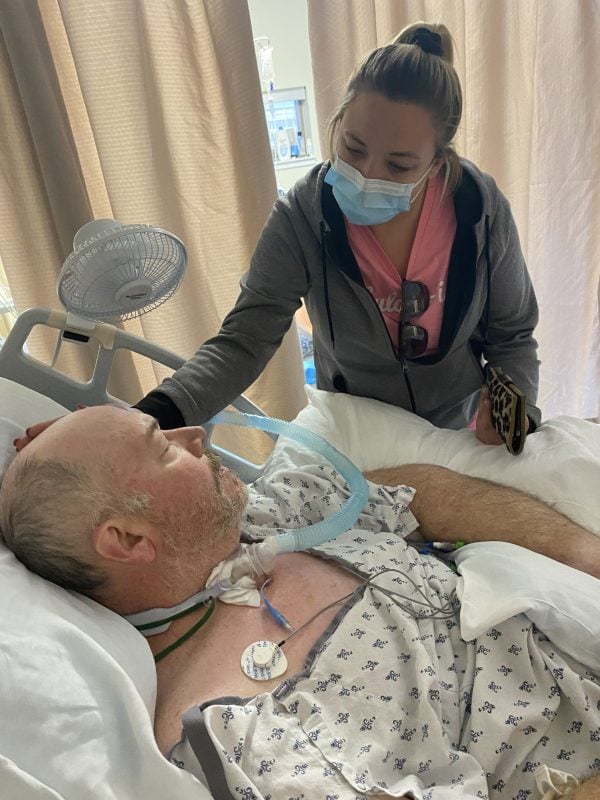
BreAnne Dillard visits her father, Tod, during his stay at a Tulsa, Okla., hospital in 2021.
At points during the pandemic, I wondered — most of us did — if it ever would end.
By the grace of God, it did.
As my Christian Chronicle colleague Cheryl Mann Bacon notes, we still talk in terms of “Before the pandemic” and “Since the pandemic.”
At points during the pandemic, I wondered — most of us did — if it ever would end. By the grace of God, it did.
But according to the Pew Research Center, the percentage of U.S. adults taking part in religious services “in some way” — in person, virtually or both — has remained quite steady.
Five years after the COVID-19 lockdown began, we mourn the lives of all those we lost. We always will.
In some ways, life returned to normal. In others, we still seem to be struggling.
Is the pandemic to blame for that or the lurking selfishness it revealed in us?
That’s up for debate. Like most everything else.
BOBBY ROSS JR. is Editor-in-Chief of The Christian Chronicle. Ross writes the Weekend Plug-in column for Religion Unplugged, where this piece originally appeared. Reach him at [email protected].
ATOKA, OKLA. — To Tod Dillard, COVID-19 was no big…

Five years ago, COVID-19 turned the world upside down. On…

ABILENE, TEXAS — “Before the pandemic.” “Since the pandemic.” Those…

Look to The Christian Chronicle for in-depth coverage of the…

Many of the 700 members of the Grace Chapel Church…

For some reason, journalists like myself have a reputation for…
Your donation helps us not only keep our quality of journalism high, but helps us continue to reach more people in the Churches of Christ community.