Oklahoma

‘We Will Never Forget’
OKLAHOMA CITY — The last week or two, I started…

|
Getting your Trinity Audio player ready...
|
OKLAHOMA CITY — “We Will Never Forget.”
That message — scrawled on a police car, printed on a memorial program, vowed by politicians and ordinary people alike — became a mantra after the April 19, 1995, bombing of the Alfred P. Murrah Federal Building.
The deadliest act of domestic terrorism in U.S. history killed 168 people — including 19 children — and injured hundreds.
Three decades later, nearly 500,000 people a year still visit the Oklahoma City National Memorial and Museum to “remember those who were killed, those who survived and those changed forever.”
“We want to make sure that the 168 people who died are not forgotten, that the survivors are not forgotten, that the heroic rescue workers are not forgotten because of an attack by a coward,” said Kari Watkins, the memorial’s president and CEO.
The day of the bombing, Gulf War veteran Timothy McVeigh parked a yellow Ryder rental truck filled with 5,000 pounds of explosives outside the nine-story federal building and got into a getaway car. The timed fuse ignited at 9:02 a.m.
Related: ‘We Will Never Forget’
McVeigh and co-conspirator Terry Nichols were convicted in the bombing. McVeigh was executed in 2001. Nichols remains behind bars, serving a life sentence at the federal supermax prison in Florence, Colo.
Memorial leaders chose “A Day of Darkness, Years of Light” as the theme to commemorate the attack’s 30th anniversary.
“God brought a lot of good,” bombing survivor Susan Walton, 74, said of the aftermath.
The devoted Christian suffered critical injuries in the blast and required 26 surgeries to recover. She still walks with a cane. But her faith remains strong.
Now retired, Walton started a nonprofit called Suited for Success after the attack. Over a 25-year period, she helped more than 10,000 low-income women achieve — as the nonprofit describes it — “self-sufficiency by providing professional clothing and career development services.”
Despite McVeigh’s evil intent, Walton said, God used the bombing’s aftermath “to show the goodness of people.”

Survivor Susan Walton speaks to the news media in 1997 as they leave the U.S. Courthouse in Denver after hearing the guilty verdict in the federal trial of bomber Timothy McVeigh.
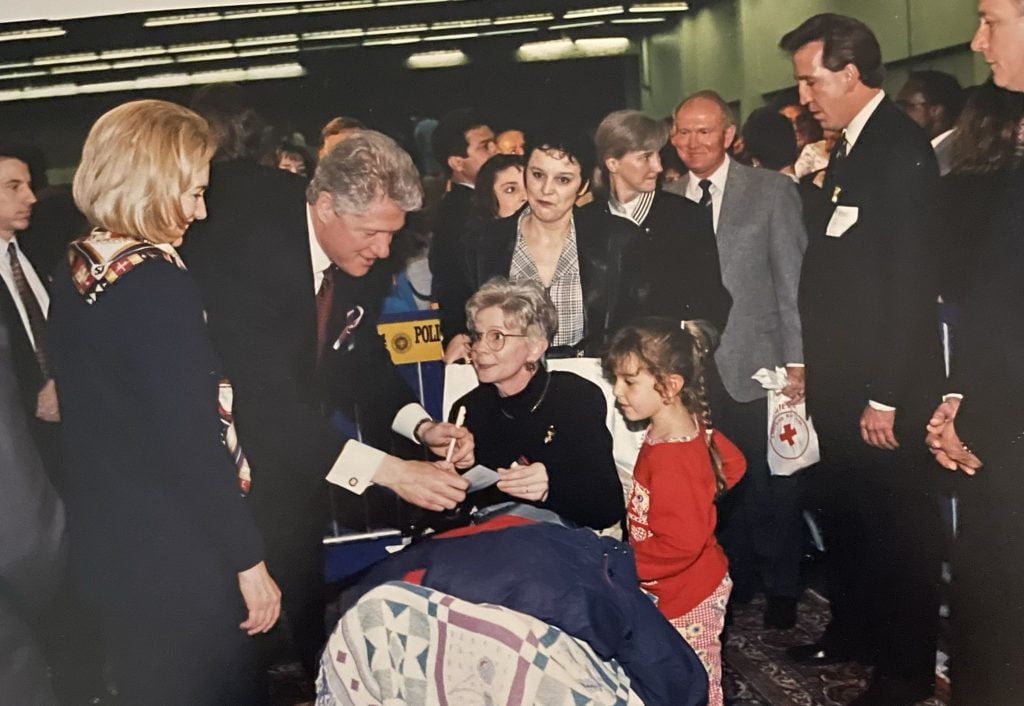
President Bill Clinton, a Democrat who drew only 34 percent of the 1992 popular vote in the conservative Sooner State, flew from Washington for a “Time of Healing” prayer service four days after the bombing.
The crowd gave him a standing ovation.
“If anybody thinks that Americans are mostly mean and selfish, they ought to come to Oklahoma,” Clinton said at the gathering. “If anybody thinks Americans have lost the capacity for love and care and courage, they ought to come to Oklahoma.”

President Bill Clinton greets Oklahoma City bombing survivor Susan Walton at a 1996 event marking the attack’s first anniversary.
Clinton will return to Oklahoma City to give the keynote speech at the 30th anniversary observance.
The ceremony Saturday morning will feature 168 moments of silence, a reading of the names of those killed and remarks from survivors, victims’ relatives and community leaders, according to organizers.
The April 23, 1995, community prayer service began the healing process for this Bible Belt state and millions of TV viewers around the world.
For three decades, “faith has played an important role in our healing,” said Watkins, an Oklahoma native hired as the memorial’s first staff member in 1996.
“We don’t run from it,” she said of Oklahoma City’s focus on faith. “It’s a part of who we are and why, I think, we’ve done so well over the last 30 years.”

Kari Watkins, right, president and CEO of the Oklahoma City National Memorial and Museum, hosted a recent panel discussion on cities impacted by terrorism.
Six years after the bombing, the 9/11 attacks by foreign terrorists on the World Trade Center and the Pentagon eclipsed Oklahoma City in sheer magnitude, claiming nearly 3,000 lives.
As time passes, fewer Americans have direct memories — or any knowledge at all — of what happened on April 19, 1995.
“I remember vividly my grandparents recounting Pearl Harbor,” Trey Orndorff, a political science professor at Oklahoma Christian University, said of the Dec. 7, 1941, Japanese bombing that thrust the United States into World War II.
But eventually — whether it’s Pearl Harbor, Oklahoma City or 9/11 — generations rise “who never lived it,” Orndorff noted.
“They cannot quite understand because it is no longer memory,” he explained, “but history.”
Still, the 1995 terror in the Heartland remains a subject of interest for many.

An exhibit at the Oklahoma City National Memorial and Museum recounts the iconic photo of a firefighter carrying victim Baylee Almon, who turned 1 year old the day before, away from the bombed building.
A new documentary, “Oklahoma City Bombing: American Terror,” will begin streaming on Netflix on Friday — the day before the 30th anniversary.
Other recent programs include National Geographic’s “Oklahoma City Bombing: One Day in America” (2025) and HBO’s “An American Bombing: The Road to April 19th” (2024).
Released for streaming this spring, the movie “McVeigh” focuses on McVeigh and Nichols.
The 2024 film depicts events leading up to the bombing — such as the conspirators’ anger about the deadly end of the federal government’s siege at the Branch Davidian compound near Waco, Texas, on April 19, 1993.
Deniece Bell-Pitner, whose 15-month-old daughter, Danielle Nicole Bell, died in the bombing, said she doesn’t speak out much because she’s a private person.
But she felt compelled to post her concerns about the “McVeigh” movie on her Facebook page.
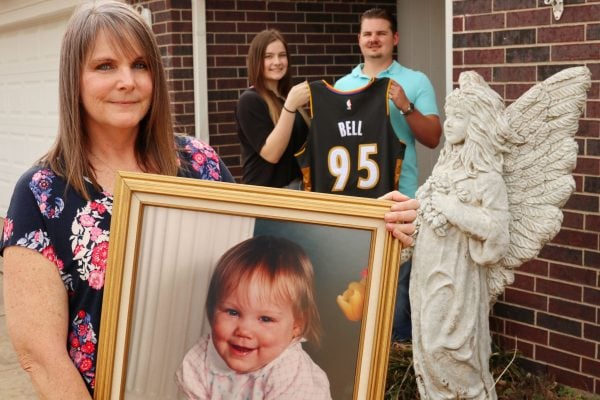
In 2020, Deniece Bell-Pitner holds a portrait of her daughter Danielle, who was killed in the 1995 bombing. In the background are Bell-Pitner’s son Brayden and daughter Dylann holding an Oklahoma City Thunder jersey created by the team to honor Danielle.
“It makes me quite sick honestly,” she wrote. “Those of us that lived it … still live it every day because of how horrible it was and the emptiness we have due to our babies, husbands, wives, loved ones being taken from us so tragically, not okay!
“I had to forgive for myself,” added Bell-Pitner, a Christian who has talked about overcoming her anger at God before she could move forward.
But she lamented that McVeigh “is getting what he wanted … being remembered while our loved ones are fading because most people don’t even realize what happened here almost 30 years ago!”

“Morning of terror” was the banner headline atop The Oklahoman’s front page the morning after the April 19, 1995, bombing.
At a recent panel discussion in Oklahoma City, Watkins and leaders of memorial sites in other cities touched by terrorism — including New York City — offered perspectives on contemporary memory, relevant history and memorialization.
“One of the things we have to remember is, our goal here is to give the family members and the survivors and the first responders a louder voice than the perpetrators,” Watkins said. “And in this crazy world we’re in, sometimes people want to focus on just the perpetrators.”
No community expects an attack like the ones Oklahoma City and New York City experienced, said Cliff Chanin, director of the 9/11 Memorial and Museum.
“And then, of course, a community comes together and tries to figure out: How do we remember? How do you memorialize” Chanin said. “And there really has been very little preparation for this, and nobody is ready for it.
“And yet family members and survivors are thrust into a position where all of a sudden, the most important thing that they face is trying to find a way for their loved one to be remembered,” he added. “How do you do that? Nobody knows how to do that, and so all of us have sort of learned along the way what that is.”
Outside the Oklahoma City museum on ground where the Murrah Building once stood, visitors find a reflecting pool, a field of 168 empty chairs, a wall of survivor names and “The Survivor Tree” — an American elm that withstood the blast.

The Oklahoma City National Memorial and Museum pays tribute to the 168 people — including 19 children — killed in the April 19, 1995, bombing of the Alfred P. Murrah Federal Building.
Inside, the story of April 19, 1995, unfolds through exhibits, theaters, interactives and real-time TV and newspaper reports.
Josh Glasscock and his wife, Jessica Cornelison, made a 300-mile trip from Bolivar, Mo., to visit the memorial on a recent Wednesday.
The couple wanted to educate 13-year-old Lane and 12-year-old Lauren on what happened and how the nation came together during that difficult time.
“It’s important,” Glasscock said of remembering. “We need to honor the victims’ lives and the survivors.”

Josh Glasscock, center, visits the Oklahoma City National Memorial and Museum with his family.
Danielle Bell, a blue-eyed, light-brown-haired baby, was one of 15 children and three adults killed in the second-floor America’s Kids Day Care.

Danielle Nicole Bell died in the bombing.
What would Bell-Pitner like people to remember about her daughter?
“I mean, she was a 15-month-old little girl that was happy all the time,” the mother said in an interview. “She wanted everybody to be happy. She wanted to make you smile.
“I mean, she liked the birds, and she liked flowers and dandelions — she thought those were flowers,” Bell-Pitner added. “She would pick those up and hand them to you. That was her.
“And she never got a chance to live her life.”
BOBBY ROSS JR. is Editor-in-Chief of The Christian Chronicle. He covered the Oklahoma City bombing for The Oklahoman in 1995. Reach him at [email protected].
OKLAHOMA CITY — The last week or two, I started…
OKLAHOMA CITY — Thirty years have not healed all of…

OKLAHOMA CITY — At 9:02 a.m. on April 19, 1995,…

ALTADENA, CALIF. — I witness a whole lot of despair.…

ATOKA, OKLA. — To Tod Dillard, COVID-19 was no big…

ROANOKE, TEXAS — Somehow, 20 years have passed since I…
Your donation helps us not only keep our quality of journalism high, but helps us continue to reach more people in the Churches of Christ community.