Faith meets machine gun nationalism

|
Getting your Trinity Audio player ready...
|
ZAGREB, CROATIA — A machine gun brought this Central European capital to a standstill on a recent Saturday.
Fans flooded into Zagreb’s Hippodrome to see singer Marko Perkovic, whose stage name, Thompson, refers to the weapon he used during what people here call the Homeland War — Croatia’s fight for independence from Yugoslavia in the 1990s, which claimed 20,000 lives.
More than half a million people bought tickets for the concert, organizers said, making it the largest paid concert in history — far larger than crowds that came to the Hippodrome to see Metallica, Ed Sheeran and The Rolling Stones in years past.
As Thompson took the stage, lighted drones arranged themselves into images of the Virgin Mary, the cross and the Croatian flag. In his opening number, “Čavoglave Battalion,” the Croatian singer proclaimed “Za dom!” (“For homeland!”). The audience yelled back “Spremni!” (“Ready!”).
Critics note that the phrase originates with the Ustasha, a Croatian nationalist group that became a puppet regime of the Nazis during World War II. But Thompson’s fans say that his music doesn’t promote fascism or animosity toward Serbs, the ethnic group that largely made up the army that fought the Croats during the war. Rather, fans say, Thompson promotes Croatian patriotism and the country’s predominant faith, Catholicism.

Mislav Ilić baptizes a new believer in the bathtub baptistery of a downtown Zagreb apartment.
On that same Saturday, a few miles from the Hippodrome, a much smaller crowd of non-Catholic Christians gathered in an apartment to celebrate their faith as they welcomed a new sister into their family. In an unassuming, caramel-colored bathtub, minister Mislav Ilić immersed one of his Bible students into Christ.
Since the early days of the war, when Zagreb’s first Church of Christ began meeting in the apartment, the bathtub baptistery has birthed hundreds of Christians. Minister Mladen Jovanović — who was himself baptized in a bathtub in 1971 by missionary Bud Pickle — guided the young church through the war years. As the Yugoslav army and Serbian militias seized cities to the east, including Petrinja and Vukovar, the church took in refugees and distributed relief.

Mladen Jovanović stands with his wife, Dragica, after his baptism in 1971. “There was no baptistery or church building, so someone’s large bathtub did the trick,” Dragica wrote in her autobiography, “Our Life Adventure.” “It was a moment of humility for Mladen. At the time, I wasn’t even aware of what was happening, and to some extent, Mladen also wasn’t aware of the significance or weight of that decision.”
After independence, Jovanović became a nationally known leader among evangelical Christians in the new nation. The church moved to a bigger facility on Zagreb’s Kušlanova Street and launched a theology school.
Ilić, Jovanović’s hand-picked successor, became pulpit minister for the Kušlanova Church of Christ after Jovanovic’s death at age 68 in 2013. About two years ago, Ilić stepped down from that role to focus on in-depth, one-on-one Bible studies with Croatians. The Saturday afternoon baptism was the latest fruit of that effort.
@christianchronicle ZAGREB, CROATIA — Goran Medved, an instructor at the Biblical Institute Zagreb, talks about the first baptisms that took place at the apartment meeting place of the first Church of Christ in Croatia. #churchofchrist #baptism #croatia🇭🇷 #zagreb #croatianchristian #bathtubbaptism ♬ original sound – The Christian Chronicle
‘Good soil for reconciliation’
Croatia, a C-shaped country with about 3.9 million people, sits at the western edge of the southeastern European region called the Balkans, though many Croats dislike the word. Some Croatians equate it with their old enemies, the Ottomans, and many outsiders associate “the Balkans” with images of warfare and destruction.
Croatia is home to 12 Churches of Christ with a total membership of about 500. Combined, all non-Catholic Christian groups represent less than 1 percent of Croatia’s population.
Ilić, his wife Snježana and the newly baptized believers they serve in Zagreb could become a new congregation. They meet for Sunday worship most weeks, but with the uncertainty of crowds and traffic they decided not to gather in Zagreb the day after the concert.

Mislav Ilić, bottom left, takes a selfie with the growing group of Christians in Zagreb that he and his wife, Snježana (last on right, second row) mentor.
Instead, Mislav Ilić drove a Christian Chronicle reporter to Varaždin, a city about 90 minutes northeast of Zagreb, where a Church of Christ was celebrating the conclusion of its summer youth camps, conducted by the church with assistance from a U.S.-based ministry, Next Generation for Christ.
When asked about Thompson, Mislav equated the singer with U.S. musicians Bruce Springsteen and Lee Greenwood. At the Varaždin Church of Christ, several Christians echoed Mislav’s sentiments. Most Croatians see Thompson’s music as patriotic — not nationalistic or evocative of the Ustasha regime, they said.

On Sunday morning, preacher Mladen Dominic speaks to members of the Varaždin Church of Christ and the families of children who participated in the church’s youth camps.
Some noted that Thompson’s most ardent fans don’t even live in Croatia. In 2013, Croatia joined the European Union, allowing its citizens to live and work in member states across the continent. Since independence in 1991, Croatia has lost nearly 20 percent of its population due to a declining birth rate and fleeing skilled workers who find high-paying jobs in Ireland, Germany and countries outside the EU. Croatians came to Thompson’s concert from as far away as the U.S., Canada and Australia.
Some church members expressed concern for the nationalistic and religious themes blended into Thompson’s performances.

Sara Crnčec
“He says some good things about God that I really agree with,” said Sara Crnčec, a member of the Varaždin Church of Christ who served as a translator during the youth camps. “But so many of his songs are based on Catholic beliefs,” she added, and tend to equate Croatian identity with the Catholic Church — in contrast to ethnic Serbs, who mostly are Orthodox.
Evangelical churches, including Churches of Christ, provide “a good soil for reconciliation” among people who tie their ethnic identity to Catholicism or Orthodoxy, said Mislav, an ethnic Croat whose wife, Snježana, is of Serbian descent. Mislav and Snježana’s grandfathers fought on opposite sides during World War II. “So we broke the generational curse,” Mislav said.
Crnčec, 19, grew up hearing stories about the Homeland War, in which her father served. It was a complicated, multifaceted conflict, she said.
And it’s in the past.
“As a younger generation, we’re trying to put all of those opinions aside and start a new page,” she said. “I’ve met a lot of Serbian people, and they are Christians like me. Their faith is beautiful. … We shouldn’t judge the book by its cover, based on nationality. (We should) really respect our brothers and sisters in Christ.”
“As a younger generation, we’re trying to put all of those opinions aside and start a new page. I’ve met a lot of Serbian people, and they are Christians like me. Their faith is beautiful. … We shouldn’t judge the book by its cover, based on nationality.”
‘We are the bad guys’
If Croatian nationalism is the price of freedom, it may be a price worth paying, Dragica Jovanović said.
“Here, nobody was openly able to talk about faith and religion and God for 30 years,” said the widow of Mladen Jovanović, a pioneer among Churches of Christ in Croatia. She and her husband were baptized and began their ministry when the country was part of communist Yugoslavia. They lived under fear of persecution and arrest by the country’s secret police.

Mladen and Dragica Jovanović in a photo from Dragica’s book, “Our Life Adventure.”
Dragica spoke with the The Christian Chronicle at her home near Lučko, southwest of Zagreb. The frontlines of the Homeland War were 10 kilometers (6 miles) from here.
“I learned to recognize the type of weapons by their sound,” she said. “When they started doing their work, our windows were shaking.”
The terrible conflict had roots reaching back to World War II and earlier, Dragica said. Josip Broz Tito, who led the Yugoslav Partisans against the Axis powers, became the country’s dictator and held its many factions together through Yugoslavia’s years as a nonaligned, socialist republic.
As a result, Croatia never had a national reckoning with its Ustasha past and the ethnic hatred that fueled the regime, Dragica said. After Tito’s death in 1980, ethnic tensions resurfaced, contributing to the wars of the 1990s and the rising tensions now.

Dragica Jovanović in 2025.
“We never solved that problem from 80 years ago,” Dragica said. “Serbians still call us Ustasha. We are the bad guys.” Some Croats still call Serbs Chetniks, referring to Serbian nationalist militias who alternatively fought against and sided with the occupying Axis powers during World War II.
Despite decades of animosity, Christians on both sides of the Homeland War found unity in the midst of conflict, Dragica said. Even as the mortar rounds fell, members of Churches of Christ in Zagreb met with their Serbian counterparts from Belgrade at a wooded park near Baja, a city in neutral Hungary.
“We would have prayers and prayers and prayers,” Dragica said. “And that was so powerful for us, that we understood God’s love and Christian love, no matter what terrible things were going on.” Croats and Serbs may take sides, but “Christians stay on God’s side.”
Sharing the same story
Back in Zagreb, Church of Christ members want new generations of believers to experience the unity demonstrated by Croatian and Serbian Christians during the war years — and to help heal the divisions that contributed to the conflict.
“Reconciliation can only come when two parties really have the same story, the same interpretation of the same event,” said Ervin Budiselić, director of the Biblical Institute of Zagreb. The institute, established in 1999, trains church leaders and publishes resources for congregations.

Nino Brozinčević, a lecturer in New Testament Greek at the Zagreb Biblical Institute, shows a copy of a Croatian-language New Testament written in Arabic and Cyrillic script.
Budiselić and other faculty members gave the Chronicle a tour of the institute’s facilities, which include classrooms in the Kuslanova Church of Christ building and an expansive theological library housed in two downtown Zagreb apartments — including the first meeting place of the Church of Christ and its bathtub baptistery.
Over lunch, the institute staffers discussed the resurgent nationalism in their country. Increased civic pride among Croatians could be a good thing, they said, especially if it results in community involvement and charity. But it becomes dangerous if you “start thinking of yourself as much higher than other nations,” Budiselić said.
“I don’t believe that reconciliation can come on the state level,” he added. “But on the micro level, God can really change people’s hearts.”

Ivan Karadža, a minister in Zagreb, shows a copy of “Bratski Vjesnik” (“Brothers’ Newsletter”), a church publication from 1968. The Biblical Institute of Zagreb houses historic church documents in an apartment that once was the meeting place of the city’s first Church of Christ.
Disciple-making — training believers after their baptisms to follow Christ and make new disciples — plays a key role in changing Croatian hearts, Mislav Ilić said. That’s a focus of his work with Bible students in Zagreb. When they meet for worship, they use one of the downtown apartments owned by the Kušlanova church.
“There’s a big table in the middle of the room that we gather around,” Ilić said. “Spiritually and literally, we gather around the table. It is so important for people to share their lives and not just come to sit in rows and watch a performance.”

Ervin Budiselić
Recently, Budiselić took a team of professors from the Biblical Institute of Zagreb to an evangelical retreat on Croatia’s Dalmatian coast. There, believers from across the Balkans worshiped together in multiple languages — Croatian, Serbian, Macedonian and Roma. The professors conducted workshops of Bible reading.
Evangelical churches in the U.S. often sponsor such gatherings, Budiselić said, but this one was conceived and coordinated by Christians in the Balkans.
“Everybody was so hugely blessed by the fellowship that we can express, regardless of our background and nationalities,” Budiselić said. “And it was … a huge testimony that, across Montenegro, Slovenia, Serbia, all of the countries of the former Yugoslavia, we came together to worship Christ.”
A machine gun can bring half a million people together for a concert, he said, but “only Christ can gather people from many nations.”

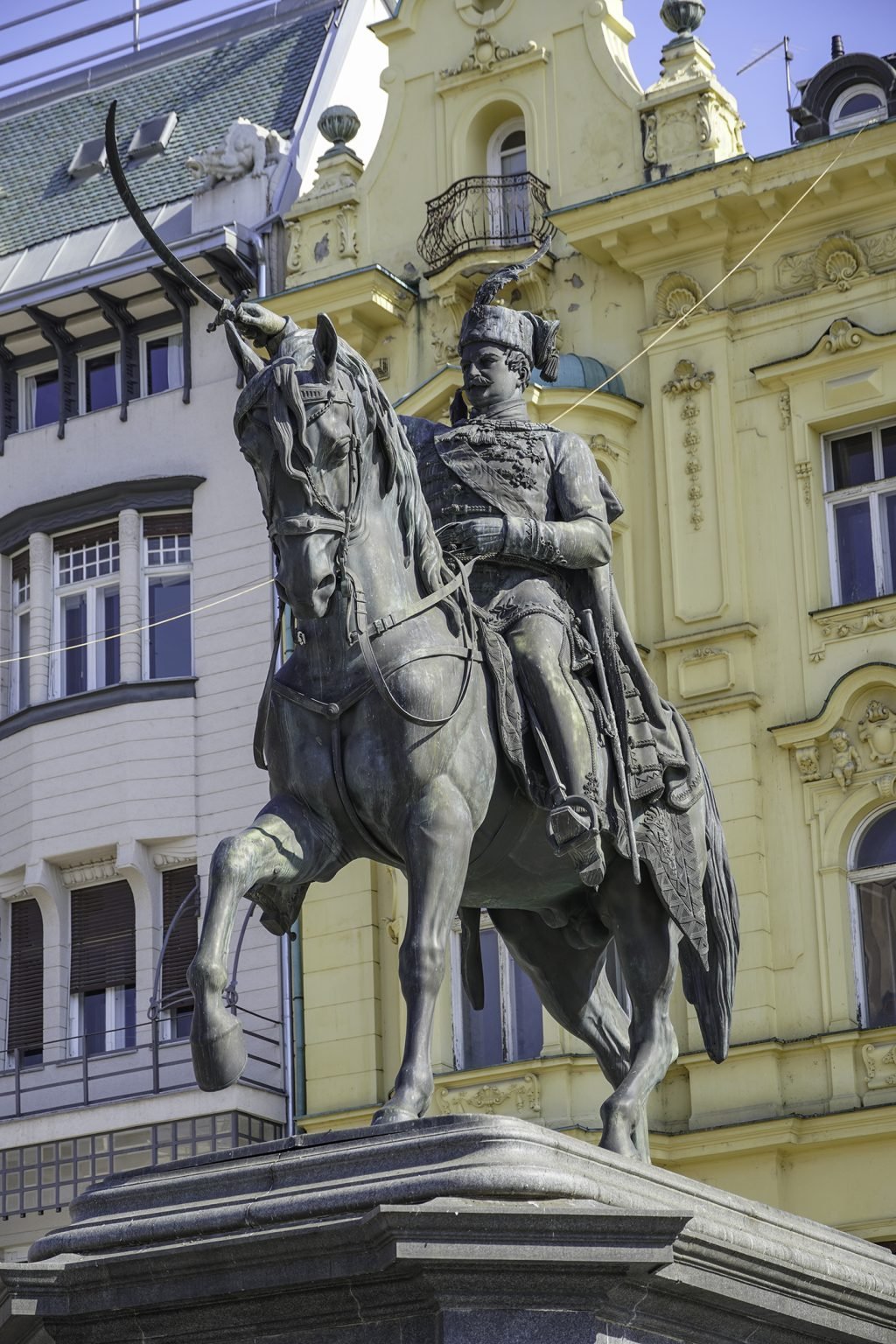
A statue of Josip Jelačić stands in downtown Zagreb. Jelačić was “Ban” (a viceroy and military office) of Croatia from 1848 to 1859. He is remembered for his military campaigns during the revolutions of 1848 and for his abolition of serfdom in Croatia.